
|
50 lei silver 2025 - Vasile Lupu - Rulers of Moldavia series |
|
|
|
|
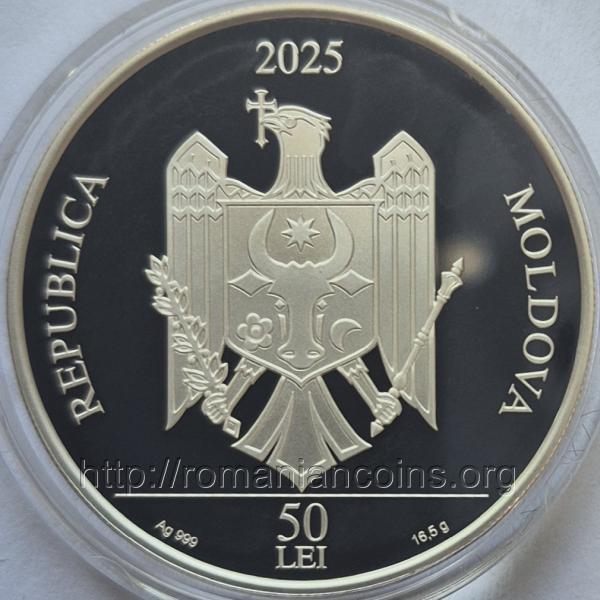
30 mm diameter, 16.5 g, 99.9% silver, grained edge year 2025, circular inscription REPUBLICA MOLDOVA meaning "REPUBLIC OF MOLDAVIA" and the coat of arms of the Republic of Moldavia, in exergue horizontal line and denomination "50 LEI", on either side of the face value the silver fineness and weight of the coin: Ag 999 and 16,5 g |
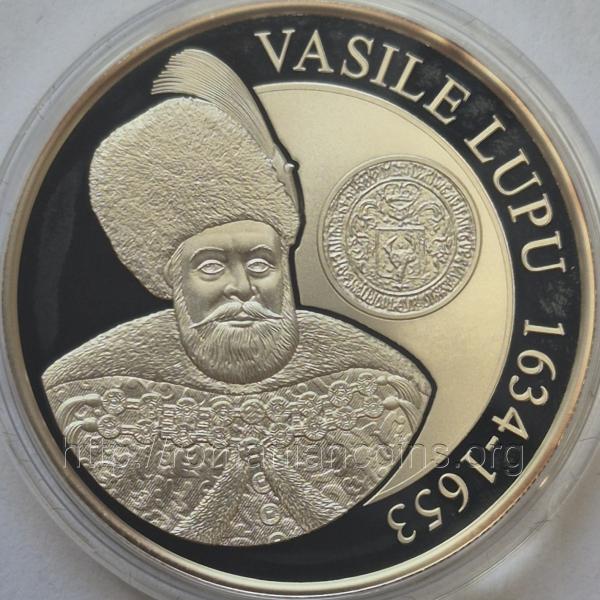
a representation of the ruler, his great seal, inscription VASILE LUPU and the years of his reign, 1634-1653
Issuing date: 2nd of May 2025 Mintage: 500 coins |
The coin belongs to the Rulers of Moldavia series.
The pictures of the coin are present on Romanian coins through the kind permission of an anonimous donor.
About the image of Vasile Lupu on the coin
The coin reproduces the well-known image of Vasile Lupu from 1651, which can also be found in [1]. It was imprinted by engraving the drawing on a copper plate. The image obtained on cardboard sheets was hand-painted and gilded. This illuminated engraving (illuminations are the brightly colored illustrations found in medieval manuscripts) is part of a series of 97 engraved and then painted portraits. The collection belonged to Laurens van der Hem (1621-1678), a lawyer from Amsterdam, and ended up in the Kupferstichkabinett (Collection of Engravings) at the Herzog Anton Ulrich Museum in Braunschweig. In the collection we also find the image of Michael the Brave made "ad vivum" by Aegidius Sadeler in Prague in 1601.
Here are some other people whose images can be found in this collection and who were more or less involved in the events in our country: Transylvanian prince Sigismund Bathory (1573-1613, engraving by Aegidius Sadeler), Emperor Rudolf II (1552-1612, engraving by Aegidius Sadeler), Polish king Sigismund III Vasa (1566-1632), Polish nobleman Albert Laski (1536-1605, the one who helped Despot Heraclid to take the throne of Moldavia in 1561), Polish king John Casimir II Vasa (1609-1672, whose coins were counterfeited in the mint established by Eustratie Dabija in the Suceava Fortress). Images of all the pieces in this collection can be found in this list, on the museum-digital:niedersachsen site.
The copper engraving depicting Vasile Lupu was made by the Dutch engraver Willem Hondius (1598-1652) in 1651 and the illumination was executed by the Dutch painter Abraham van Westerveld (1620-1692). This information appears inscribed at the bottom of the engraving: Abraham van Westerveldt pinxit, Wilhel. Hondius scupl: Cum privilegio S.R.Mtis. Gedani M.DC.LI. Gedani obviously refers to the city of Gdansk, which at that time was called in Latin - civitas Gedanensis.
Willem Hondius moved from The Hague in the Netherlands to Gdansk in Poland in 1641. He worked as engraver for King Władysław IV Vasa of Poland. The Dutchman participated at the military campaign of 1651 that resulted in the conquest of Kiev by the Lithuanian hetman Janusz II Radziwiłł (1612-1655) and the defeat of the Cossacks of hetman Bogdan Khmelnytsky (~1595-1657) in the Battle of Beresteciko (today in Ukraine). The future Moldavian chronicler Miron Costin, very young in 1651, participated in this battle on the side of the Poles.
About the great seal of Vasile Lupu
In Romanian dictionaries, seal is a piece with a graphic representation engraved in negative. It therefore represents a seal pattern or matrix, which is usually made of metal and has a handle for easier application. The impression of the seal matrix on a document or on a piece of wax attached to the document is also called seal. As a rule, seal matrices have been lost, being currently known only through the images left on various documents. The presence of a seal on a document serves as an assurance of its authenticity.
In [2] more than 250 seals used by the chancellery of the rulers of Moldavia between 1387 and 1856 are known and listed. Of these, nine types are from the reign of Vasile Lupu.
The seal on the coin is presented in the form of a photograph in Constantin C. Giurescu's "History of the Romanians" [1]. The impression is found on a round piece of wax, which in turn is attached to the document with a (silk) string.
In 1978, the Direcția generală a Arhivelor Statului (General Directorate of State Archives, or D.G.A.S.; since 1996 the name of the institution is Arhivele Naționale ale României - the National Archives of Romania) decided to produce copies of several seal impressions, namely copies of some considered to have great historical and national importance [3]. In addition to copies of the originals, several seal matrices were also made (some at a 1:1 scale, others "much enlarged"). The image of the original seal was usually reconstructed, because the existing impressions were poorly imprinted or had been deteriorated more or less over time. In total, 12 seal matrices were produced, for seals from Mircea cel Bătrîn, Roman Mușat, Alexander the Good, Iancu of Hunedoara, Stephen the Great, Mihai the Brave, Matei Basarab, Vasile Lupu, Grigore Ghica, Constantin Brâncoveanu, Constantin Mavrocordat and Alexandru Ioan Cuza [3]. The seal of Vasile Lupu used as a model can be found at the Bucharest State Archives [3]. The piece of supporting wax has a diameter of 9 cm.
The main graphic element of the seal is a shield bearing the head of the Moldavian aurochs. Between the horns of the aurochs is a six-rayed star. To the right of the aurochs's head is a new moon and a spear, and to the left is the sun and a sword. According to Giurescu [1], the sword symbolized the fact that the ruler exercised the supreme judicial power ["jus gladii" - the right to pronounce the death penalty], and the lance - the fact that he was the head of the army. Just above the shield is a helmet decorated with large lambrequins. The lambrequins descend on the sides of the shield. Above is a closed crown bearing a cruciger globe in the middle.
Between two pearl circles is the inscription in Slavonic ✝ PECIAT IO VASILIE VOEVODA B(O)JIO MIL(O)STIO G(O)SPODAR ZEMLI MOLDAVSKOI VLT 7142. The text uses several ligatures and abbreviations.
The inscription translates as + Seal of Io Vasile voivode by the ghrace of God ruler of the Country of Moldavia year 7142.
The year 7142 Anno Mundi (to the creation of the world) corresponds to the year 1634. In the times of Vasile Lupu, Cyrillic writing still used letters to denote numbers. Thus, the letter З = Z has the numerical value 7, the letter Р = R has the value 100, the letter М = M has the value 40 and the letter Б = B has the value 2. Before the number 7, there is the sign for thousands, ҂, a modifier that shows that the next digit represents thousands and not the usual value. As a result, the date is obtained by adding: 1000 * 7 + 100 + 40 + 2 = 7142. Since the counting of years began on September 1st, in order to reach the usual counting, 5508 years must be subtracted for dates before September 1, or 5509 years in the other case. The result of subtracting 7142 - 5508 is 1634, the exact year of Vasile Lupu's accession to the throne. The ruler had effectively taken the throne in Iași on May 7, New Style date [1].
Other old images of Vasile Lupu and of his family
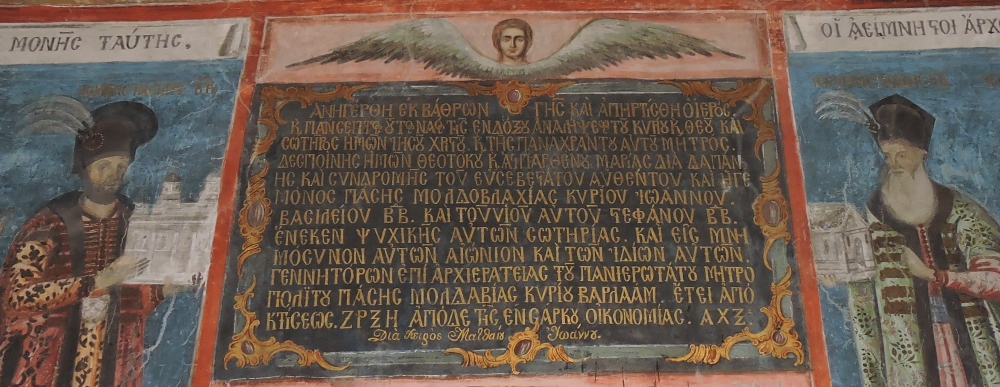
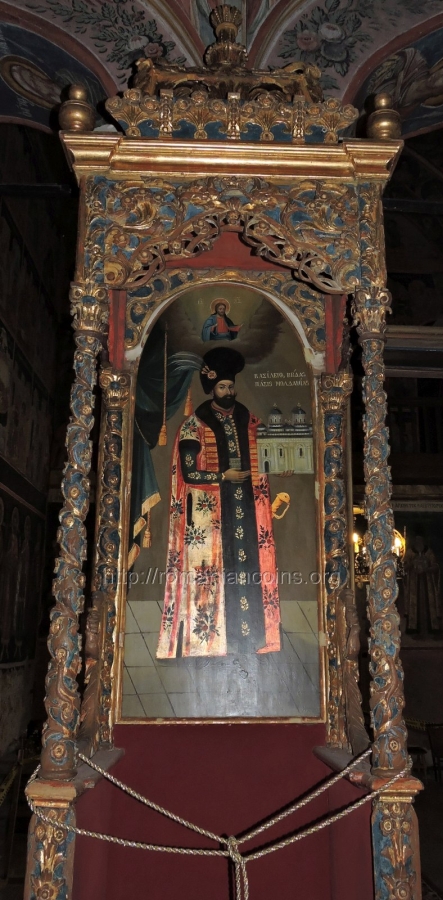
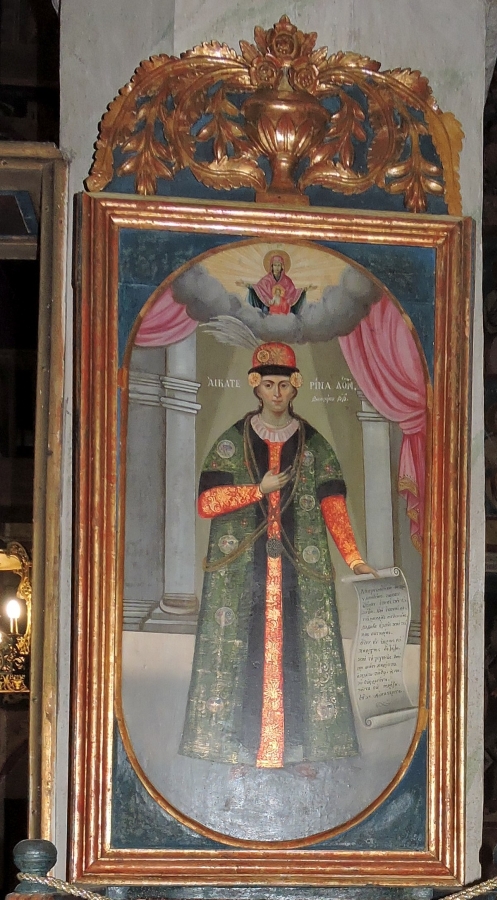
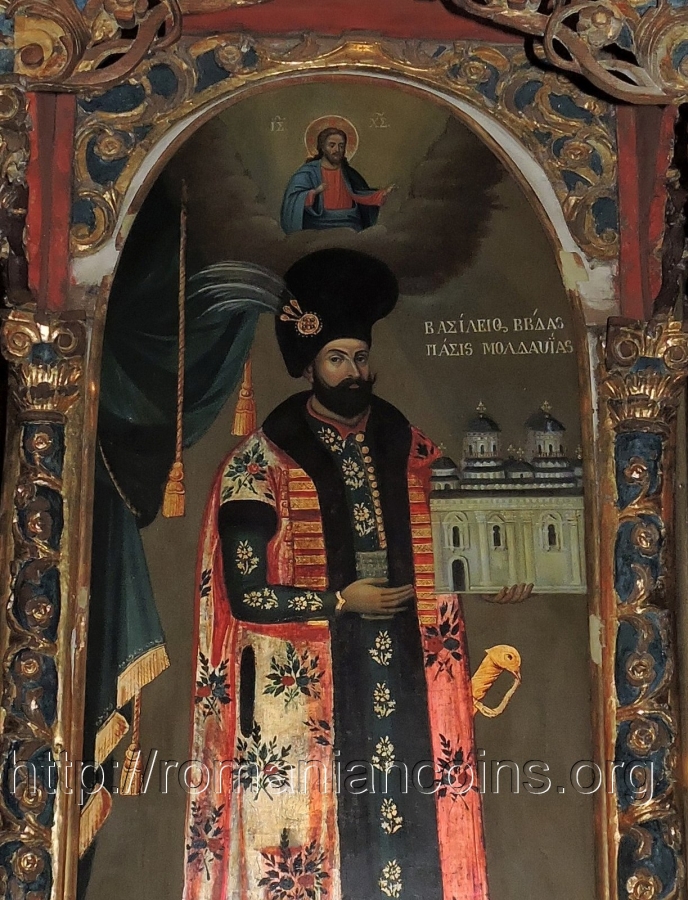
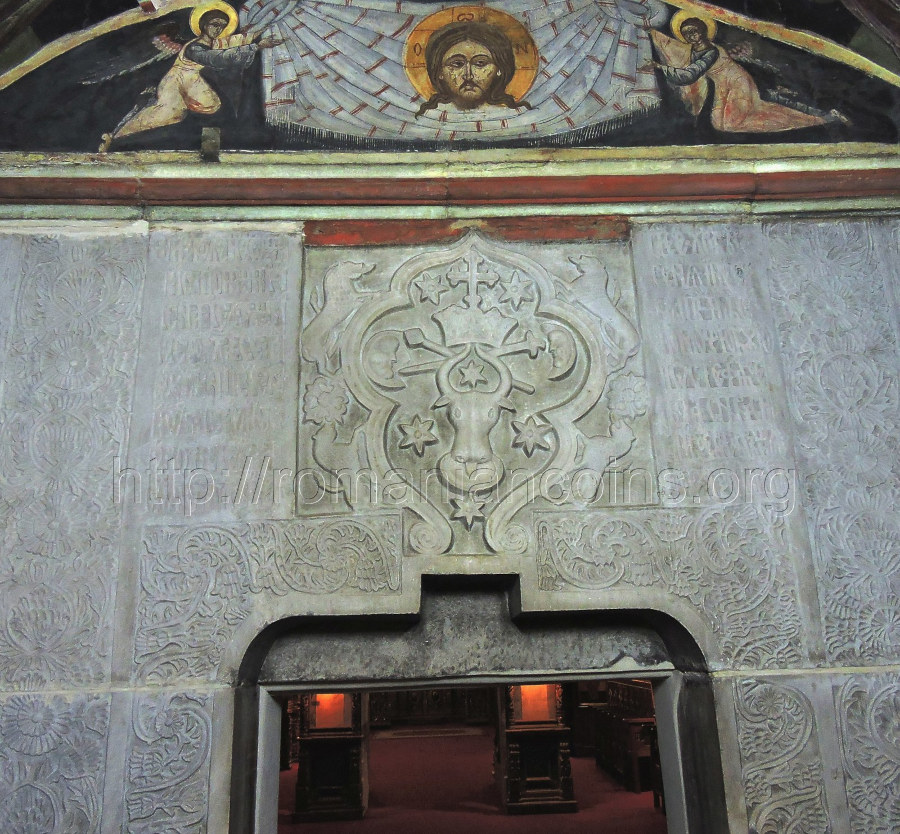
Two old images of Vasile Lupu are preserved in the church of the Golia Monastery in Iași. Vasile Lupu (together with his family) rebuilt the old church of the logothete Ioan Golăi between 1650 and 1653. The works were finished by Ștefăniță, the ruler's son, in 1660.
Vasile Lupu appears in one of the two votive paintings above the entrance in the nave of the church, alongside his second wife - Ecaterina - and their son Ștefăniță. The ruler is also painted on the back of the prince's chair. On the back of the lady's chair is painted Ecaterina, his second wife.
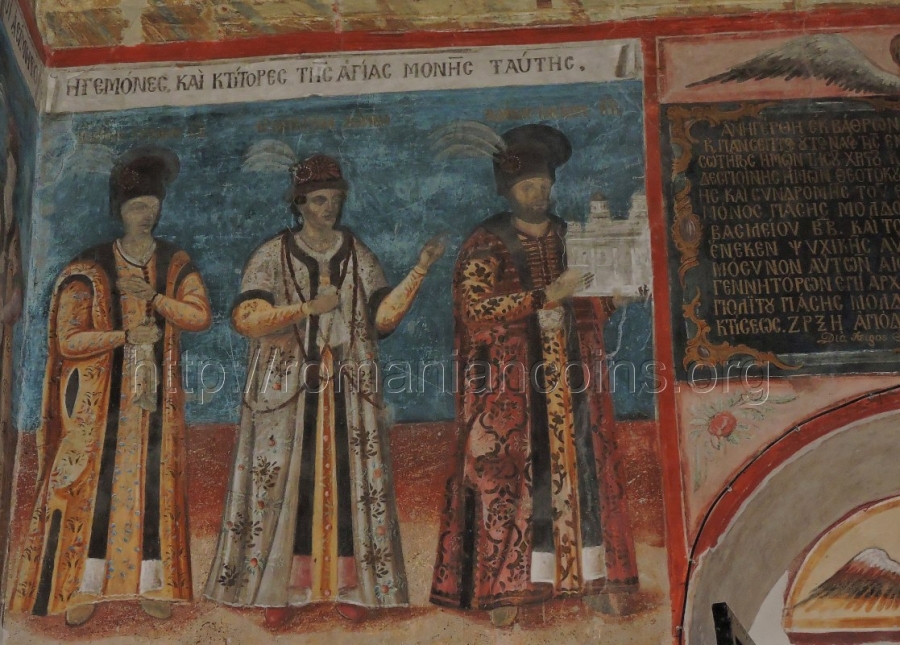
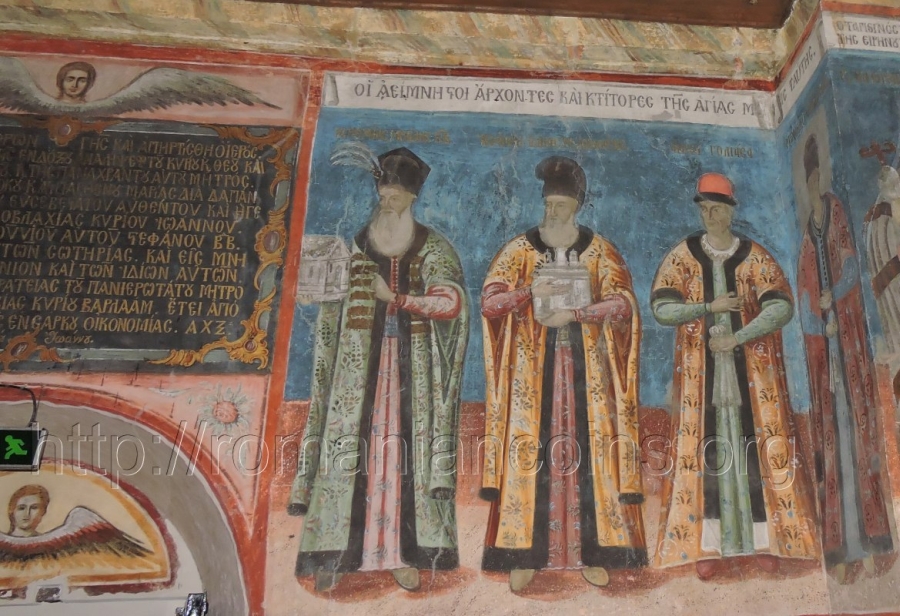
It is noticeable that the characters in the votive paintings are not equal in status, although they are all founders. The three rulers and Vasile Lupu's wife have panache fixed to the hat by a clasp. The logothete Ioan Golia, Ieremia Movilă and Vasile Lupu each hold a model of the church in their hands, a sign that they are the most important founders. All the others - Ștefăniță Lupu, her mother Ecaterina and Ana Golia (and other people painted further left and right) each hold a bag of money in their hands, symbolizing monetary contributions.
References
1. Giurescu C., Istoria românilor. III. De la moartea lui Mihai Viteazul pînă la sfîrșitul epocii fanariote (1601-1821). Editura BIC ALL, București, 2007.
2. Szemkovics L.-Șt., Dogaru Maria, Tezaur sfragistic românesc II. Sigiliile emise de cancelaria domnească a Moldovei (1387-1856). Editura Ars Docendi, București, 2006.
3. Drăghici Natalia, Dogaru Maria, Mulaje sigilare realizate de Arhivele Statului în sprijinul activităţilor cultural-educative. Revista Arhivelor, Anul LXIV, vol, XVIX, nr. 3, 1987.
|
Back to selection page!
|