
|
5 lei 2006 - 150 Years European Commission of the Danube |
|

|

|
|
37 mm diameter, 31.103 g, silver 99.9%, flat edge Obverse: year 2006, Romanian coat of arms, ROMANIA, face value 5 LEI, map of Danube Delta | Reverse: pelican, Danube River, ship Carolus Primus near Sulina lighthouse, inscription "COMISIA EUROMEANA A DUNARII 1856 - 2006" meaning "EUROPEAN COMMISSION OF THE DANUBE"
Issuing date: 21st of August 2006 Mintage: 500 coins |
The coin celebrates 150 years from the internationalization of the juridical regime of the Danube and from the establisment of the European Commission of the Danube, implicitly celebrating the Paris Peace Treaty of 1856, that ended the Crimean War and included some stipulations favorable to Romanians and to the future Romanian state.

Crimean War. The Peace Conference of Paris
In 1853 emperor Nicholas I of Russia demanded to sultan Abdul-Mejid to grant Russia the protectorate over the Orthodox Christians inside the Ottoman Empire. The demand was refused and in October 1853 the war between Rusia and Turkey had already begun, the last being allied with France, Great Britain and the Kingdom of Sardinia. The war was won by the allies, being christened Crimean War after the main operation theatre. The peace conference took place in Paris, in February and March 1856.
The Conference of Paris decided that the Romanian Principalities be put under the guarantee of the great European powers, though remaining under Turkish sovereignty. The Russian protectorate was abolished. The organizing of the ad hoc Divans in Moldavia and Walachia was decided also at Paris. These Divans were to decide the future organization and the Union of the Principalities.
About European Danube Commission
At the Peace Conference of Paris were decided the freedom of navigation on the Danube, the establishment of the European Commission of the Danube (with the main siege at Galaţi) and the neutrality of Black Sea. Russia was pushed back from Danube for approximately 20 kilometers, and as a consequence the counties of Bolgrad, Cahul and Ismail (southern Basarabia) were retroceded to the principality of Moldavia (the three counties were once again stolen by Russia in 1877).
Romania became a member of the Commission with full rights in 1877, after the proclamation of the independence.
The town of Galaţi (the second larger town of Moldavia at the time, that had remarkably developed after 1829, the year when the Turkish monopoly over Moldavian exports was abolish, was the seat of the European Commission of the Danube from 1856 till 1948.
After the First World War the Commission resumed its activities, going under the name of International Commission of the Danube.
About the Danube Commission
In June-August 1948 the Conference of Belgrade created a new Danube Commission, with riverine communist countries as members only: Czechoslovakia, Hungary, Jugoslavia, Romania, Bulgaria, USSR and Ukrainian SSR. The non-riparian countries were excluded, Austria joined the Danube Commission in 1960 and the Federal Republic of Germany refused to participate. The center of the new organization was not at Galaţi anymore but at Budapest.
After the fall of the communism the Danube Commission had 11 members: Germany, Austria, Slovakia, Hungary, Croatia, Serbia, Romania, Bulgaria, the Republic of Moldavia, Ukraine and the Russian Federation. The member states are represented in the Commission by ambassadors accredited in Hungary.

About the Lighthouse and the Palace of the European Commission of the Danube
The lighthouse was built on the right bank of the Sulina branch between 1857 and 1870, having been designed by engineers sir Charles Hontley and M. Engelhardt.
Built between 1860 and 1868, the Palace was seat to the European Commission of the Danube over to 1921. Nowadays it houses the River Administration of the Lower Danube Galaţi, Waterways Section Sulina, located at the crossroads of Street I and Diuliu Zamfirescu.
Both buildings are historical monuments and are protected by the state.
About the ship Carolus Primus
The ship Carolus Primus - whose name obviously means Carol I - was a yacht used by the European Commission of the Danube for inspections. The European Commission of the Danube had the custom of naming its vessels after persons who had made important services to the institution. Thus, a steam dredge was named after Sir Charles Hartley (1825-1915, the first chief engineer of the European Commission of the Danube, nicknamed "Father of the Danube"). Other ships were Percy-Sanderson, Carl Kühl (1844-1919, a Danish engineer who worked for the C.E.D.), E. Magnusson, Dimitrie Sturdza. It seems that King Carol I of Romania was a constant supporter of the Commission's activities.
The oldest news about the ship Carolus Primus that we found dates back to 1885. The newspaper Universul (The Universe) of April 24, 1885 informs us [1]:
"On Saturday, General Pencovici, member of the European Commission, arrived in the port of Tulci [Tulcea] with the new commission ship, the Carolus primus.
The construction of the ship is very elegant; it has tastefully furnished cabins, and in each of them the insignia of one of the eight powers that make up the commission are painted."
In 1909 the old ship Carolus Primus was replaced by another. In this regard, the newspaper Universul of June 22, 1909 informs us that [2]:
"The State Fisheries Administration has purchased from the European Commission the yacht <<Carolus Primus>> which has been named <<Principele Nicolae>> [Prince Nicholas]. It will serve for the princely family for excursions in the Delta.
The European Commission has purchased from England a new larger yacht, which it will name <<Carolus Primus>> ; yesterday both yachts were received."
The information from the period newspapers above was found in the Arcanum Newspapers database.
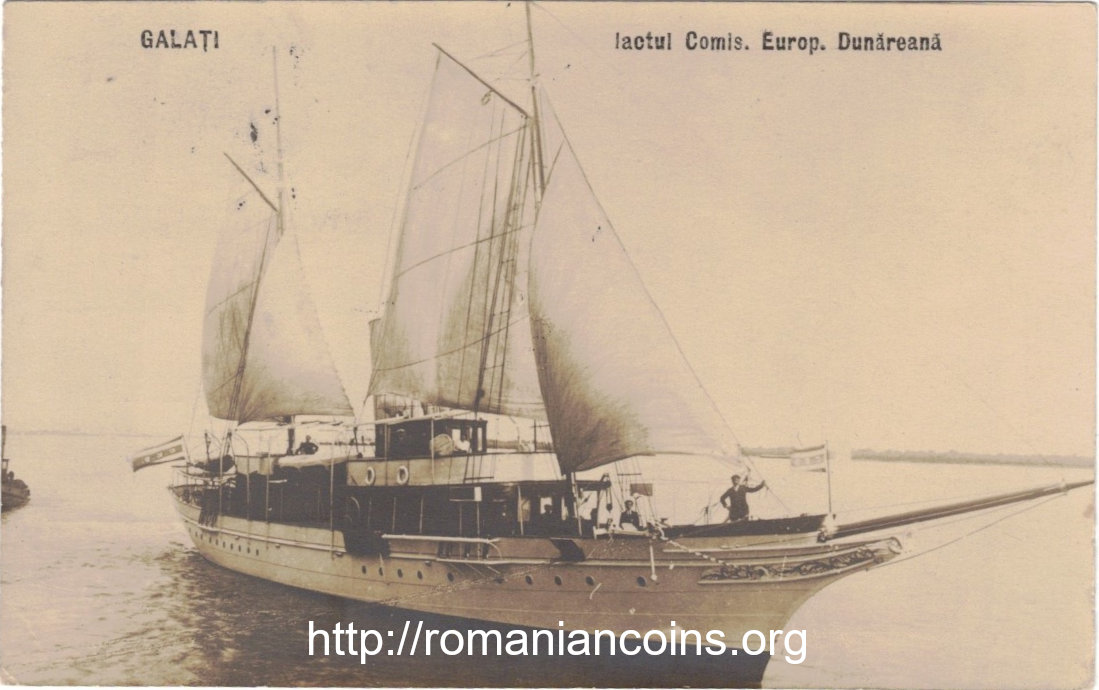
The ship depicted on the coin is the one purchased in 1909. It was built in Scotland by the firm A. & J. Inglis Ltd. of Glasgow, and was launched on 16th of April 1903 [3]. The yacht was originally called Oithona. Oithona had steel hull and was powered by a three-cylinder steam engine with diameters of 10, 16 and 27 inches, through which the steam passed successively. The piston stroke was 22 inches [4]. In 1909, Oithona was purchased by the European Commission of the Danube and was renamed Carolus Primus.
Entering into Romanian service in 1938, the yacht Carolus Primus was used by the German Military Air Mission in Romania (Deutsches Luftwaffe Mission in Rumänien) [5]. The German Air Mission was under the command of Wilhelm Speidel (1895-1970), who upon his arrival in Romania in October 1940 held the rank of lieutenant general [6]. The yacht was used by the Luftwaffe until 1942. In 1948 the ship's name was changed again, becoming Neptun (= Neptune; obviously, the old name was incompatible with the new communist regime established in Romania). After the war the yacht was repaired and used as a training ship and then as a cruise ship on the Black Sea. It was erased from the navy registers in 1971 [5].
The name Oithona was coined by the Scottish poet James Macpherson (1736-1796) as the title of a prose poem. Oithona was said to have been the daughter of a king, and the name means Maiden of the Wave in Scottish Gaelic - a very appropriate name for a yacht made in Scotland.
An aluminum essay of this coin is presented below.

|

|
|
37 mm diameter, 7.33 g, aluminum, flat edge |
In 2003 the NBR issued a series of three 50 lei silver coins dedicated to the International Year of the Pure Water - Danube Delta Biosphere Reserve. On these coins were presented three species of birds from Danube Delta: pelican, egret and blue kingfisher.
Another (thin) numismatic connection: the Romanian writer Ion Heliade Rădulescu, represented on the bimetallic gold-silver coin of 2000 lei 2002, participated at the Crimean War as officer in the Turkish army, being observed at Varna, in the camp of Fuad-Pasha, by some fellow Romanians.
|
Back to selection page!
|