
|
G. Musatti tokens - Bisoca |
|
| 
|
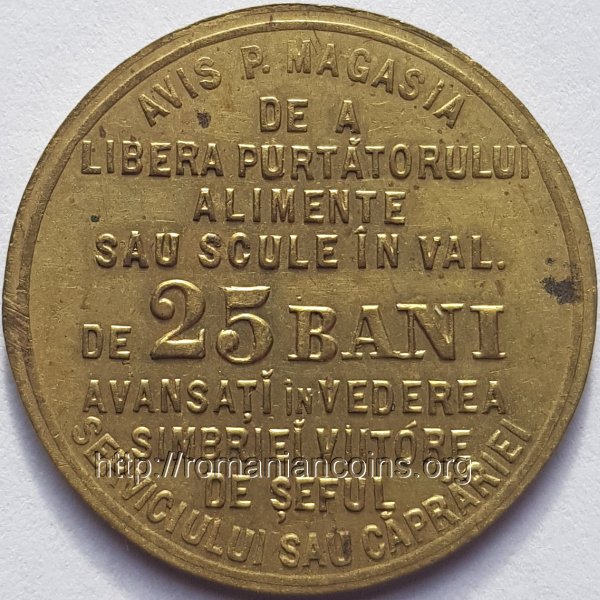
| 24.6 mm, ? g, brass? inscription (on several rows) AVIS P. MAGASIA DE A LIBERA PURTĂTORULUI ALIMENTE SAU SCULE ÎN VAL. DE 25 BANI AVANSAŢI ÎN VEDEREA SIMBRIEI VIITÓRE DE ŞEFUL SERVICIULUI SAU CĂPRĂRIEI meaning NOTICE F.(or) STOREHOUSE TO RELEASE TO THE BEARER FOOD OR TOOLS IN VAL.(ue) OF 25 BANI ADVANCED IN VIEW OF THE FUTURE SALARY BY THE HEAD OF THE SERVICE OR (of) THE GROUP |
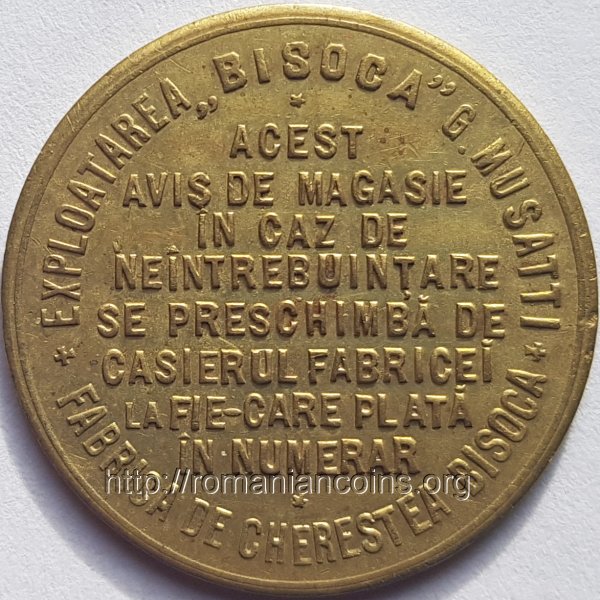
circular inscription ✝ EXPLOATAREA „BISOCA” G. MUSATTI ✝ FABRICA DE CHERESTEA BISOCA, meaning "BISOCA" EXPLOITATION G. MUSATTI ✝ BISOCA TIMBER FACTORY, in the middle inscription (on several rows) ★ THIS STOREHOUSE NOTICE IN CASE OF NON-USE IS EXCHANGED BY THE FACTORY CASHIER AT ANY CASH PAYMENT ★ |
The village of Bisoca is located in Buzău county. Unfortunately, no information was found (on the Internet, in December 2023) about G. Musatti's exploitation in Bisoca. The "căprărie" would be the popular name for a group of soldiers, a formation usually commanded by a soldier with the rank of corporal. Instead of corporal, a homophone word was used, namely "căprar" meaning goatherder (which comes from a Romanian word more familiar to the soldiers more than a century ago, "capră" meaning goat).
The Romanian writer Alexandru Odobescu mentions Bisoca in the 11th chapter of his book "Pseudo-cynegeticos" [1]: "I was now on the top of the hills under which the village of Bisoca shelters, like in a trough". Thence one could could see far, faraway, being able to identify also "the Dobrogean hills, hemmed with the steamy cord of the Danube". Odobescu vividly describes the landscapes nearby the village of Bisoca: "[...] There to be seen, on the Bisoca and Ulmuşorului peaks, lay large grizzle and roan stones, some piled together, as herds of cattle gathered at rest, others scattered through the orchards, like the cows when grazing wanderingly". Bisoca peak is 973 m and Ulmuşorul peak is 880 m [2]. The following is a story about an emperor's son who "sat down to rest on one of the worn boulders on the Ulmuşor hill, just above the stone pass, which we call the Dragons' Stable, because there used to take shelter, in ancient times, the winged beasts". It is clearly a mention about dragons, which, according to Odobescu, would have lived in our country in the past...
What else is there to say? The well-known Romanian artist Nicolae Grigorescu (1838-1907) created a painting called "Bisoceanca" (that is woman from Bisoca), in which a peasant woman from Bisoca appears. Apparently, the first mention of Bisoca tokens is from 2003 [3].
References
1. Odobescu A.I., Pseudo-cynegeticos. Editura Minerva, Bucureşti, 1979.
2. Lahovari G.I., Brătianu C.I., Tocilescu Gr., Marele Dicţionar Geografic al Romîniei : alcătuit şi prelucrat după dicţionarele parţiale pe judeţe. Volumul 5. Bucureşti, Stab. Grafic J.V. SOCECŬ, 1905.
3. Schäffer E., Şeptilici R.-M., Ilin M., Jetoane româneşti inedite ori mai puţin cunoscute (IV). Buletinul Societăţii Numismatice Române. Anii XCII-XCVII (1998-2003), Editura Academiei Române, Bucureşti, 2003, p. 231-260.
|
Înapoi la pagina de selecţie!
|