
|
fise de jog game tokens (chips) |
|
|
|
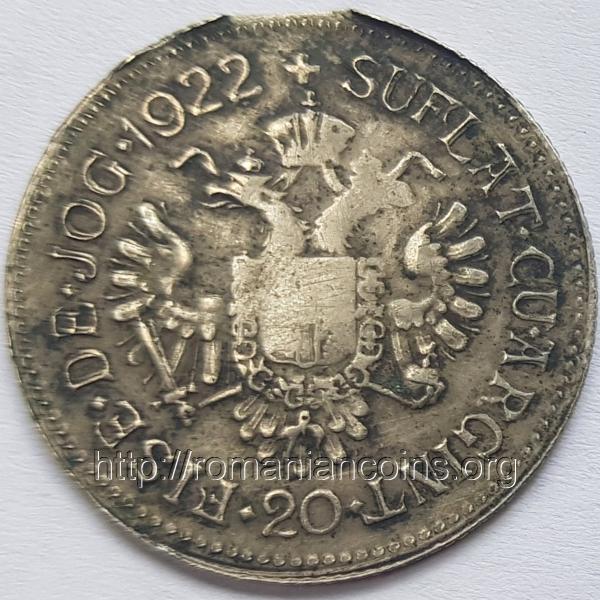
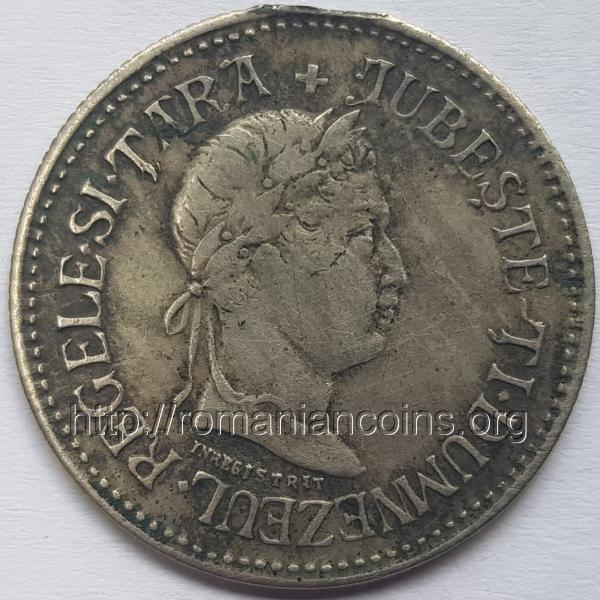
| 28 mm, 4.31 g, silvered metal outer pearl circle, crowned double-headed eagle, with a shield bearing a coat of arms on the chest, with sword and globus cruciger in its talons, circular inscription FISE ⬪ DE ⬪ JOG ⬪ 1922 ✚ SUFLAT ⬪ CU ⬪ ARGINT ⬪ 20 ⬪ meaning GAME CHIPS 1922 SILVERED | outer pearl circle, laureate head right, circular inscription ✚ JUBEŞTE-ŢI ⬪ DUMNEZEUL ⬪ REGELE ⬪ SI ⬪ ŢARA maning LOVE YOUR GOD KING AND COUNTRY, under the effigy inscription INREGISTRIT meaning REGISTERED |
In the monograph "Jetoane, semne valorice şi mărci" [1] 29 different models of such chips are presented. Three main types could be identified, all imitating old Austrian or Austro-Hungarian coins. The first model is about 20 mm and imitates the gold ducats of Austria, which had this diameter. The head on the token looks very much like Emperor Francis Joseph (Franz Joseph) in his youth, and the coat of arms is practically the coat of arms of Austria. On the tokens of this type it is written "GILDED". The second type is approximately 26 mm in diameter and imitates the Austrian silver coins of 20 kreutzer, also called "sfanţi" in Romanian, from the German name Zwanziger [or zwanzig = 20] which indicates the value of 20 units. The diameter of the original coins is approximately 28 mm, quite close to the imitation, which also bears the value indication, 20. The face could be that of the young Emperor Franz Joseph, or of the Emperor Ferdinand. Ferdinand I (1793-1875) reigned from 1835 to 1848, and Franz-Joseph I was Emperor of Austria from 1848 to 1916. The third type is about 40 mm, which corresponds well with the diameter of the Austrian 4 ducat gold coins. On these tokens it also written "GILDED".
The tokens are dated, in [1] being reported as pieces from the years 1922, 1923, 1924 and 1925. It is possible that these tokens were used instead of real coins as stakes in various card games. (By the way, even today poker sets that include several decks of playing cards and several hundred chips with different numerical values are produced.) The existence of three types would have allowed for different stakes. Using chips instead of real coins would have avoided any accusation of gambling. Since 1904 [2] in Austria-Hungary numerous games, mostly games of chance, were prohibited. For example, you were not allowed to play pharaoh, baccarat, stoß, poker or thirty-one (the last one named in Romanian by its Turkish name of otuzbir, which actually means thirty-one). The writings JUBEŞTE-ŢI, INREGISTRIT and JOG instead of IUBEŞTE-ŢI, ÎNREGISTRAT and JOC suggest that the producer of these pieces did not know Romanian very well.
[1] also lists tokens similar to a Zwanziger (but of a different model), inscribed in Romanian and Hungarian, from the years 1908-1913.
References
1. Schäffer E., România. Jetoane, semne valorice şi mărci, Guttenbrun [old German name of Zăbrani village in Arad county], 2012.
2. * * *, List of games prohibited in Austria-Hungary., Wikipedia, accessed November 2023.
|
Back to sitemap page!
|