
|
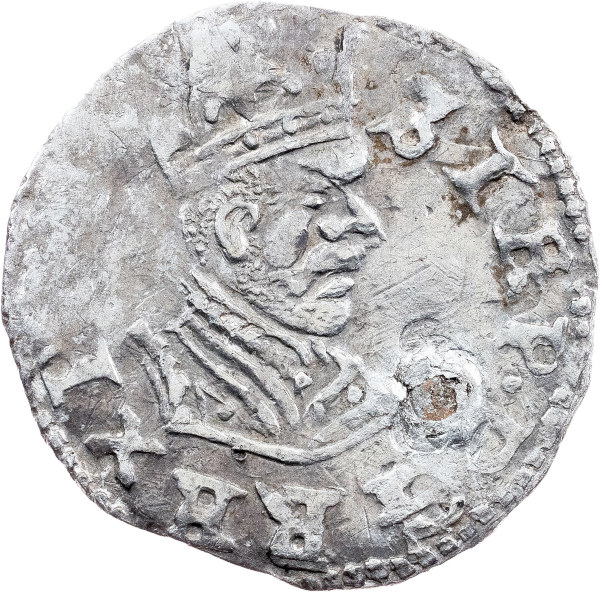
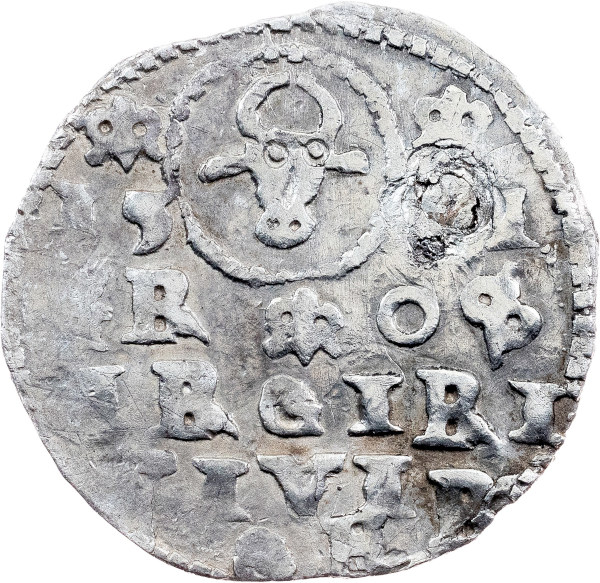
imitation of a Polish trojak from 1581, with aurochs head, in the MBR attributed to the rule of Ieremia Movilă |
|
|
|
|
~20 mm diameter, 1.012 g, silver Obverse bust of king Stephen Báthory to the right, crowned, outer pearl circle and circular inscription STEP • DGREXPOD |
Reverse aurochs head inside a pearl circle, at left, right and below a lily flower, on sides 15 81; outer pearl circle, inscription on four rows: GR OS / ARG IRI / CIVI R / GE |
The images of this piece are present on the site courtesy of the auction house Pešek Auctions from the Czech Republic. The piece was sold in 2026 for more than 6000 €.
The obverse of this piece appears in the monograph "Monede și bancnote românești" - Romanian Coins and Banknotes - MBR [1] - at position 815 (legend STEP • DGREXPOD) and the reverse (with the letter S from GR OS rotated to the left and with the letter R from the name of the city of Riga placed slightly lower than the other letters on the same row) at position 813.
Moldavian coins imitating Polish and Lithuanian three silver groat (3 grosze or trojak) coins
In medieval Moldavian numismatics, several types of more peculiar coins are known, which look quite similar to the Polish 3 silver grossi pieces. Almost all of them feature an aurochs head, interpreted as the coat of arms of Moldavia. Some of these are usually attributed to the ruler Ștefan Răzvan (1595), others - to Ieremia Movilă (1595-1600, 1600-1606). It is assumed that the coins attributed to Ștefan Răzvan could have been minted only in Transylvania [2], since there is no evidence of the existence of a princely mint in Moldavia around 1600, which would have made local minting possible.
According to MBR, these pieces are called "Moldo-Polish" coins.
In Poland, the first 3 grosze [called as well troyak] coins were minted at the Kraków mint in 1528 [3], during the reign of Sigismund I the Old (1467–1548, King of Poland from 1506). In Transylvania, the first local 3 grosze coins were minted in 1594 [1]. The silver troyak coins were very successful, being minted for a long time and circulating in many countries, Moldavia included.
Older and newer bibliographical references to these pieces
In the 19th century, the numismatist Emeryk Hutten-Czapski (1828-1896) gathered a large collection of Polish coins and medals, presented in a 5-volume catalogue. In the first volume, published in 1871 [4], a piece of type MBR 815 is drawn and described among the coins of Stephen Báthory (King of Poland between 1576 and 1586) as a Riga triple grosz with wrong legend, struck with a crude die. It is stated that the reverse depicts a bull's head with horns and it is believed that it is probably a contemporary silver forgery, perhaps a "Moldavian imitation". [It should be noted that before being elected King of Poland, Stephen Báthory was voivode of Transylvania. Several Transylvanian ducats bearing his name are listed in MBR.]
The oldest Romanian reference to a Moldavian 3 grosz coin that we have found is in Bogdan Petriceicu-Hasdeu, at word "ban" in Etymologicum magnum Romaniae [5]. Here a coin attributed to Ștefan Răzvan appears, on which the year 1595 and the inscriptions MOL DOB and MOOLDABIA appear.
But Bogdan Petriceicu-Hasdeu states that all the material regarding Romanian numismatics and published in the article "ban" was made available to him by D.A. Sturdza. It is interesting to note that Dimitrie A. Sturdza (1833-1914, numismatist, academician, several times prime minister of Romania) published in the magazine Numismatische Zeitschrift, 4, 1872, the article "Uebersicht der Münzen und Medaillen des Fürstenthums Romanien (Moldau und Walachai)" [Overview of the Coins and Medals of the Principality of Romania (Moldavia and Walachia)] in which the piece attributed to Ștefan Răzvan is not presented.
It results that Sturdza (and probably other Romanian numismatists) learned about the Moldavian three-grosz coins sometime between 1872 and 1893. It is also likely that Sturdza is the one who decided that the issuer would be Ștefan Răzvan. The key elements that could have led to such an attribution are the nominal value of three silver grossi (so the coin must be from the period when the trojak was circulating), the reference to Moldavia, the aurochs head (as coat of arms of Moldova), the name Stephan and the year 1595. But these are only our assumptions. In the literature that was available to us, we could not find exactly who and based on which criteria established the issuers of the 3-grossi coins with the aurochs head. Ștefan Răzvan had a very short reign, only between April 24 and an unspecified day in August 1595. It can be reasonably assumed that his reign was too short to mint coins.
A photograph that appears to be of the piece attributed to Ștefan Răzvan, with a drawing from Hasdeu / Sturdza, unfortunately small in size, was published in 1970 by Octavian Iliescu [6].
In [3], a Polish book on trojak coins published in 2008, a coin of the type MBR 816 is illustrated, with a shield having the outline made of chained rings in which there is an earless aurochs head. The author shows that there was a mint in Suceava that produced counterfeit small coins and states that during the reign of Ștefan Răzvan, Polish three grosze pieces were imitated there.
Compared to the time when the MBR was compiled (the book was published in 1977), today there is the great advantage of the Internet. In August 2026 we found on the Internet photos of some pieces described in the MBR but also images of some new pieces. For example, there are combinations of dies of the pieces in the MBR. Some images "come out" when searching on Google. Others can be found in the archives of some auction houses.
The Polish numismatic forum TPZN [7] has collected, starting from 2012 and up to the present, under the topic "Na tropie imitacji trojakowych" [On the trail of trojak imitations], almost all the images relevant to the topic (spread over more than 30 pages). Most of them come from pieces put up for auction on the Internet and from collectors. A few pieces seem to be modern reproductions. Others seem to have a much too flat surface.
About the license of Ieremia Movilă to mint coins equivalent to Polish ones
In the fifth volume of the "Uricariu" ["uric" means "charter"] by Theodor Codrescu from Iași (1819-1894), there is a document written in Latin [8] in which King Sigismund III (1566-1632, King of Poland between 1587 and 1632) speaks about the reign of Ieremia Movilă and about the organization of Moldavia. The document, given in Warsaw on March 25, 1597, is presented in the "Uricariu" as a treaty concluded between the King of Poland and the ruler of Moldavia. A paragraph refers to the possibility of minting coins in Moldavia. In [8], the translation into Romanian (written with Cyrillic letters) is also given. The fragment that interests us is this: "Hereby, we empower the great Movilă to mint coins, still in the image of the Polish, that is, of the same proof, size, measure and of the same monetary sign, so that they can circulate in Poland and in our other dominions". [The document had been published in Moldavia by Bogdan Petriceicu Hasdeu in 1859 in "Foaea de Storiă Română", Jassy, Year of the Union I, but Hasdeu's version does not exist digitized, unlike Codrescu's.]
This means that the Moldavian ruler had acquired the right to mint coins that had the same material, size, appearance and value as Polish coins, so that they could circulate freely in the territories ruled by Sigismund III (he was not only king of Poland but also grand duke of Lithuania and ruler of other territories).
But, apud [9], the Polish Senate did not approve the 1597 treaty, or at least the monetary clause. The evidence comes from the report of the papal nuncio in Warsaw of March 27, 1597.
This story about the license to mint coins is also found at other authors, for example in [2] and [6].
Although the treaty did not enter into force and therefore the license to mint coins was not granted by law, the coins described in MBR as having been minted by Ieremia Movilă "can be attributed with all certainty to Ieremia Movilă's attempt to transpose the monetary clause" of the treaty into reality, Kirițescu believes [2].
A few observations on the trojak-type pieces described in the MBR
If we read the descriptions in the MBR, we will notice several problematic elements:
1. MBR 809 and 810a - 3 grosze type I, Ștefan Răzvan (with the drawing reproduced after Hajdeu / Sturdza 1893)
- on the pieces it is written STEP II - why would the inscription Stephanus II designate Ștefan Răzvan?
- why is the basically Latin inscription on the obverse - BOIBOD MOL DOB - written using Cyrillic V, i.e. B?
- why is a Polish mint sign present on the reverse?
- again, what is the letter B (Cyrillic V) doing in the Latin inscription on the reverse?
2. MBR 810 - 3 grosze type I, Ștefan Răzvan (same obverse but different reverse)
- on the coin it is written REG POLONIE - on what reason would Ștefan Răzvan have minted coins in 1595 that would also be valid in Poland? This right was almost granted to Ieremia Movilă in 1597, but the Polish Senate did not agree.
- the year inscribed on the coin is an impossible one for Ștefan Răzvan - 1589.
- the reverse is copying, with almost all its elements, the reverse of some troyaks minted in 1589 at the royal mint in Olkusz in Poland. This explains the presence of the year 1589 on the coin (in the MBR the year is written as 15-89?, with ? after).
3. MBR 811 and 812 - 3 grosz type II, Ștefan Răzvan (with two sketches)
- on the obverse the inscription is in Slavonic - IO STEFA VOEVODA BJIO - on what reason does Ștefan in the inscription designate Ștefan Răzvan?
- two reverse variants are described, one imitating a triple grosz of the Kingdom of Poland, the other - one of the Grand Duchy of Lithuania; what reason would there be for an official issue to use more than one variant?
4. MBR 809, 810, 810a and 811 (all bearing the coat of arms of Jan Dilski and - apart from MBR 809 - also his initials, I D - of course, the initials are for the Latin version of the name)
- in Polish heraldry the same coat of arms was used by several families (even dozens!; it was not necessary for them to be related; there were a few more than 150 such coats of arms);
- Jan Dulski (1534-1590, spelled Dilski in MBR) was, among other things, the treasurer of the crown between the years 1580 and 1590; the Dulski family bore the Przegonia coat of arms - a red shield, with a silver sword pointing downwards, on each side a golden crescent; Jan Dulski is the only bearer of the Przegonia coat of arms who left numismatic traces on the three grosze coins;
- in [3] several troyaks with Dulski's shield are presented, minted in the mints of Poznan and Olkusz;
- in 1595 Dulski had already been dead for five years, so the presence of his coat of arms is an obvious anachronism!
5. MBR 813 - 817 - 3 grosze, Ieremia Movilă (with a drawing, imitates pieces of Stephen Báthory)
- for 5 pieces described, 5 different dies were used for the obverse and another 5, also different, for the reverse - what reason could there be, for an official issue, to use more than one variant?
6. MBR 818 - 820 - 3 grosz, Ieremia Movilă (no drawing, imitates pieces from Sigismund III)
- for 3 described pieces 6 different dies were used - what reason would there be for an official issue to use more than one variant?
We can imagine that a coin forger would have been interested in producing several different types of coins, with different years and inscriptions. As is the case with Eustatius Dabija's shillings, which have hundreds of variants [1]. Only in this way could the coins - after all, of rather modest value - have been placed in circulation in large numbers at once. What seller would have received a handful of identical coins from a buyer without becoming suspicious?
All of these pieces are actually exactly what they seem at first glance: just fakes.
Recently - in a scientific article from 2010 [10] - numismatist Viorel Butnariu calls these pieces "the so-called Moldavian-Polish coin issues". In 2012, the author examined several such pieces and concluded that they are all fakes [11]. Unfortunately, the 2012 paper was presented at the 13th Numismatic Symposium held in Chișinău, Republic of Moldavia, and the organizers published only a volume with abstracts, the full papers not being printed later. In another article, from 2013, [12] Butnariu said that all these pieces "are fakes produced by coin forgers in Moldavia, at the latest in the following decades".
This idea is supported by the images of a trojak sold by the Numision Auction House [13] in 2022 on One Bid. The piece imitates a troyak minted for Stephen Báthory at the Olkusz mint. The original piece has the inscriptions ·STEPHA·D G·REX·PO·M·D·L· respectively III N H GROS·ARG TRIP·REG POLONIÆ 15 85 I D and bears the coat of arms of Jan Dulski [14].
The imitation bears the inscriptions STEPIIA DG REX [POMDI] respectively III GROS ARG IRIP REG POIONI 15 85 and the coat of arms of Jan Dulski.
At first glance, the imitation does not seem to have any connection with the trojaks with the coat of arms of Moldavia. Upon closer inspection, it is clear that the imitation presents great similarities to the piece on this page and to other so-called "Moldo-Polish" coins. Let us observe the evidence (we did not obtain the right to display the images of the imitation sold in 2022 on the site, so the reader must open the link from the reference [13] in the References himself).
1. The letter S from GROS is rotated to the left on both coins. Even though we only have pictures, not the actual coins, and we cannot know the exact size, the letters S appear to be identical on both coins, in all 4 appearances - on GROS and on STEP.
2. On both TRI from TRIP visible form is IRI, with I instead of T.
Points 1 and 2 lead us to the idea that the dies of the two pieces were engraved by the same person.
3. The Numision piece has another characteristic, namely the abundant use of the letter I instead of other letters. Thus, on the reverse I replaces the T in TRIP, and in POLONI we have I instead of L, and the letter N (moreover presented as mirrored!) is made of two I's, obviously connected to each other by a manually added segment, which at the bottom exceeds the base. On the obverse STEPHA is written with two I's, i.e. II instead of H, and the T seems to be the same I. The last letter of the inscription, L in MDL, is again replaced by I. It would result that the engraver did not have the letters T, L, H and N at his disposal and therefore had to improvise.
4. The observation that STEPHA is written on the Numision piece with II instead of H immediately brings us to mind several pieces from the MBR. Thus, the MBR piece 816 bears the inscription STPEIIA, and the MBR pieces 809, 810 and 810a the inscription STEPII. In all these cases the letter H was made of two I's, without the horizontal bar, suggesting that all these pieces are the work of the same engraver, who did not have the letter H in his set of punches.
5. To clarify that STEPII and STEPIIA represent Stephen Bathory, we need to look at how the king's name is written on authentic coins. In Iger's book [14] on trojaks minted for Stephen Bathory at the Olkusz mint, the variants STEP, STEPH, STEPHA, STEPHAN and even STEPHANUS are found.
Based on the common features, we can appreciate that the Numision coin proves to have the same origin as some of the three-grosze coins with an aurochs head presented in the MBR, being produced in the same workshop. It remains a task for the future to identify other products of this illicit coin workshop. Perhaps someday archaeologists will come across the remains of the workshop, with minted pieces, scraps, pieces of sheet metal from which the coins were cut, just as traces of mints producing counterfeits were found in Suceava [15] and Snagov [16]).
Romanian numismatist Constantin Moisil (1876-1958), who analyzed the aurochs headed trojaks in 1915, mentioning at least four variants existing in the collection of the Romanian Academy [15], put it very nicely in the cited work: "The problem cannot be definitively resolved with the means we have today." The situation, after over 100 years, has not changed at all.
On the legends on the imitated Polish three-grossi silver coins [17]. A few trojaks
GROS ARG TRIP REG POL is completed as "grossus argenteus triplex regni Poloniæ", translated as triple silver grosz of the Kingdom of Poland.
GROS ARG TRIP CIVI RIGE is completed as "grossus argenteus triplex civitatis Rigensis", translated as triple silver grosz of the city of Riga. Nowadays Riga is the capital city of Latvia.
GROS ARG TRIP M D L is completed as "grossus argenteus triplex Magni Ducatus Lithuaniæ", translated as triple silver grosz of the Grand Duchy of Lithuania.
STEP DG REX POL is completed as "Stephanus dei gratia rex Poloniæ", translated as Stephen, by the grace of God King of Poland.
SIG III DG REX PO M D L is completed as "Sigismundus III dei gratia rex Poloniaæ magnus dux Lithuaniæ", i.e. Sigismund III , by the grace of God King of Poland and Grand Duke of Lithuania.
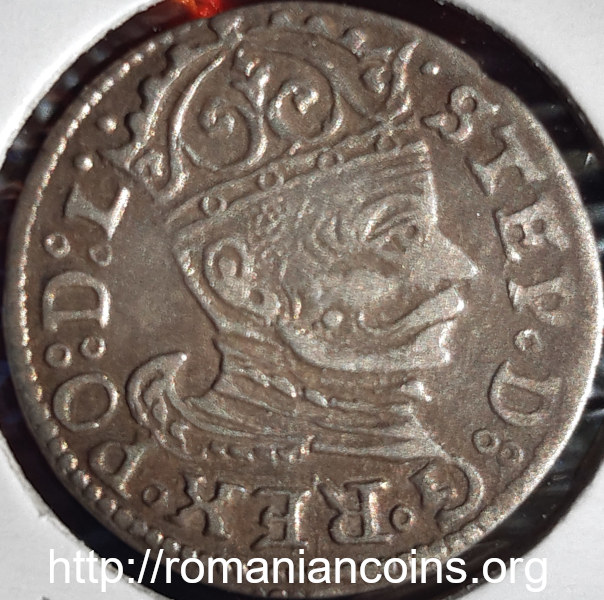
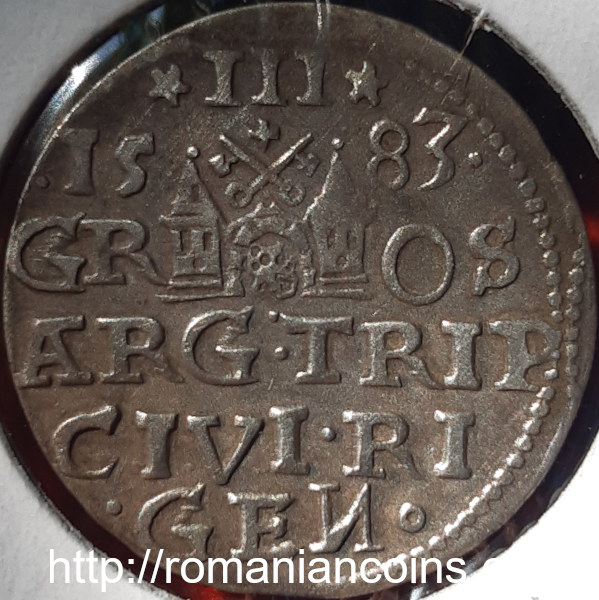
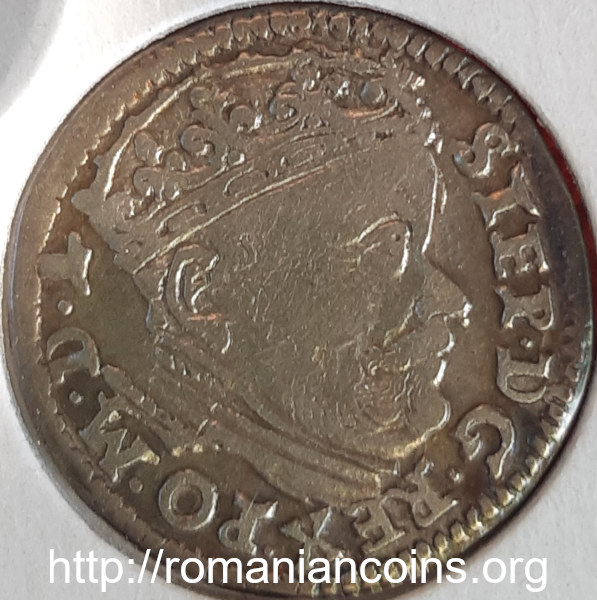
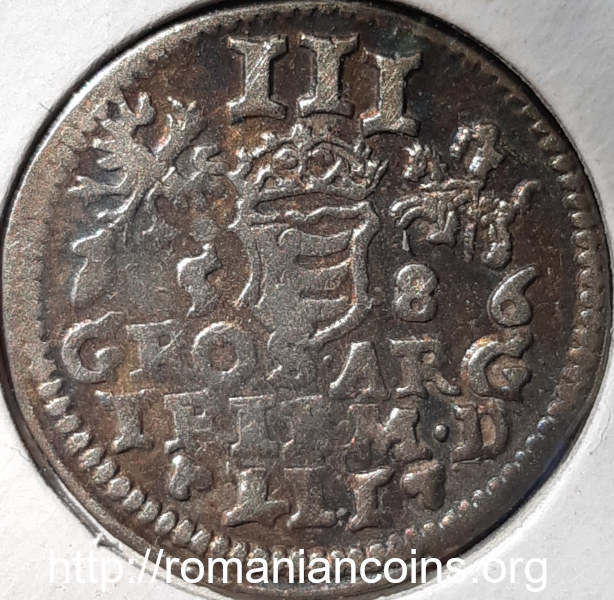
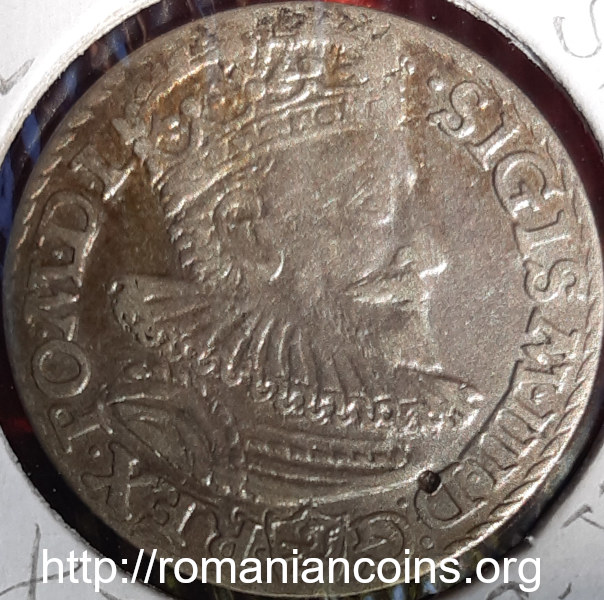
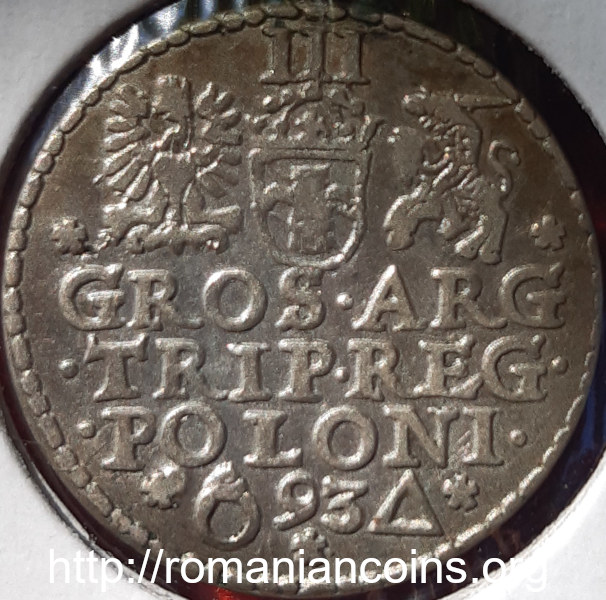
To give an idea about the difference in appearance and quality between the originals and the imitations, we have added images of three trojaks minted at different mints and in different years. The images appear by courtesy of an anonymous donor.
|
|
|
~20 mm diameter, silver, ? grams - Riga mint, coin R.83.1d in Iger catalog [14] Obverse bust of Stephen Báthory to the right, crowned, outer pearl circle and circular inscription • STEP ⚬ D:G⚬REX⚬PO:D:L•• |
Reverse outer pearl circle, coat of arms of the city of Riga (city gate, two crossed keys and a cross above), six-rows inscription 🟊III🟊 / •15 83• / GR OS / ARG:TRIP / CIVI•RI / •GEИ⚬ |
|
|
|
~20 mm diameter, silver, ? grams - Vilnius mint, coin R.86.1d (variant) in Iger catalog [14] Obverse bust of Stephen Báthory to the right, crowned, outer pearl circle and circular inscription STEP • DG• REX• PO• M• D• L |
Reverse outer pearl circle, coat of arms of Poland (eagle), crowned coat of arms of Báthory family (with three wolf teeth) and coat of arms of Lithuania (knight in armour, on horse), five-rows inscription III / 15 86 / GROS• ARG / TRIP•M•D / 🟂 LIT 🟂 |
|
|
|
~20 mm diameter, silver, ? grams - Malbork mint, coin M.93.1a in Iger catalog [14] Obverse bust of Sigismund III to the right, crowned, outer pearl circle and circular inscription • SIGISM • III • D:G • REX• PO• M• D• L; between DG and REX a shield with a lion, the coat of arms of Jan Firlej, treasurer of the Polish Kingdom |
Reverse outer pearl circle, 🟊, coat of arms of Poland (eagle), crowned coat of arms of Vasa family (with a sheaf of wheat) and coat of arms of Lithuania (knight in armour, on horse, holding a raised sword), 🟊, five-rows inscription III / GROS • ARG / •TRIP•REG• / •POLONI• / 🟊 93 △ 🟊; before 93 a ring, the sign of Kasper Goebel, the mint's lessee; the triangle is the sign of the Italian minter Gratian (Gracjan) Gonzalo |
What was the value of a trojak at the time?
The production of trojaks was very large during the reigns of Stephen Bathory and Sigismund III [3]. But the minting of small coins was stopped by the Sejm in 1627. This included the 3 grosze pieces, the minting of which was resumed in 1650. Reference [3] also shows that in Poland the three silver grosz pieces were called potrójny or trojaki, meaning triple. Nowadays on German-language websites the trojak is usually called 3 Groscher, Dreigröscher or Düttchen (although the "dutca" would rather be the 3 shilling piece).
How much silver was a trojak supposed to contain after the 1580 reform?
It would be useful to find out how much silver was supposed to be in a trojak according to the mint’s regulations. The coins we are interested in were minted after the monetary reform carried out in 1580 by Stephen Bathory. He unified the monetary systems of Poland and the Grand Duchy of Lithuania, which had been significantly different until then. The monetary ordinance of 1580 is written in Latin and was published in 1845 by Ignacy Zagórski (1788–1854) [18]. The part of the ordinance that interests us regulates the minting of silver coins starting from the largest - thaler and down to the smallest - denarius. The document from 1580 was extracted from "Metryki Koronnej" [Records of the Kingdom of Poland] volume 123, pages 272-276, a book in which documents issued by the royal chancellery were recorded. In 1580 the document was of course handwritten (and can currently be found scanned on the Internet).
The texts regarding the minting of thalers, 6 silver grosz (szóstak), trojaks and grosz, taken from [18] and verified according to "Metryki Koronnej", are presented below.
Ita nempe, quod argentum, ex quo Thaleri et medii Thaleri cudentur, continebit in se argenti mixti lotos tredecim cum dimidio, ex quo quidem mixto argento, confecti Thaleri septem, marcae unius dimidiique scoti pondus habebunt. Argenti autem puri sive fain continebunt in se lotos tredecim cum dimidio. Ex marca autem argenti fain cudentur octo petiae, grossi decem, obuli quatuor. Ita quod petia quaelibet per triginta quinque grossos computata, marca argenti puri sive fain in Thaleris, novem florenis, viginti grossis, et quatuor obulis, ex eadem officina efferetur.
Marca vero argenti, ex qua sex grossorum grossi cudentur, quemadmodum et ea, ex qua Thaleri cudi debent, mixti argeuti in se continebit lotos tredecim cum dimidio. Ex ejusmodi vero argenti mixta marca, petiae quadraginta una et viginti duae trigesimae secundae partis, ex Marca vero fain petiae quadraginta novem conficientur. Ita quod marca una argenti fain, ex eadem officina efferetur florenis novem, grossis viginti quatuor, obolis quatuor.
Marca vero argenti, ex qua triplices grossi cudentur, quemadmodum et ea, ex qua Thaleri cudi debent, mixti argenti in se continebit lotos tredecim cum dimidio. Ex ejusmodi vero argenti mixta marca, petiae octuaginta duae et undecima sedecimae partis, ex marca vero argenti puri sive fain petiae nonaginta octo conficientur. Ita quod Marca una argenti fain efferetur florenis novem, grossis viginti quatuor, obolis quatuor.
Marca ex qua simplices grossi cudentur argenti, continebit in se quinque lotos, tres quintas, ex qua quidem marca mixta petiae, seu grossi centum sex et una sexagesimae quartae, ex marca autem fain petiae ducentae nonaginta quinque conficientur. Ita quod Marca una fain in grossis efferetur florenis novem, grossis viginti, medii vero grossi iuxta proportionem simplicium grossorum cudentur et efferentur.
We give below, in a looser translation, the Latin text above.
Thus, namely, that the silver from which thalers and half thalers are minted shall contain in itself silver alloy of thirteen and a half lots, from which silver alloy, seven Thalers made will have the weight of one mark and a half skojec. But pure or fine silver shall contain in itself thirteen and a half lots. And from the mark of fine silver eight pieces shall be minted, ten grossi, and four obols. So that each piece is calculated for thirty-five grossi, the mark of pure or fine silver in Thalers, nine florins, twenty grossi, and four obols, shall be brought out from the workshop.
But the mark of silver from which grossi of six grossi are minted, like that from which thalers are to be minted, shall contain in itself silver alloy of thirteen and a half lots. But from this kind of silver alloy mark, forty-one pieces and twenty-two thirty-second parts shall be made, and from the Mark of fine forty-nine pieces. So that one mark of fine silver, from the same factory, will brought out nine florins, twenty-four grossi, four obols.
But the mark of silver, from which triple grossi are minted, just as that from which thalers are minted, will contain silver alloy of thirteen and a half lots. But from such mark of silver alloy, eighty-two pieces and eleven sixteenths of a part, and from a mark of pure silver ninety-eight pieces will be made. So that one mark of fine silver will be brought out for nine florins, twenty-four grossi, four obols.
The mark from which simple grossi are minted will contain five lots of silver, three fifths of a part, from which indeed mark of alloy one hundred and six grossi and one sixty-fourth, and from a mark of fine silver two hundred and ninety-five pieces will be made. So that one mark will be minted in grossi od nine florins, twenty grossi, but half grossi will be minted according to the proportion of simple grossi.
In the Middle Ages, the mark was a unit of mass (weight), equal to half a pound. The mark was divided into 4 wiardunek or ferton (quarters), 8 ounces, 16 lots, 24 skojec, 96 grains, 240 dinars or 480 obols. There were many marks with different masses, depending on the city or country. In Poland, the local mark, the Krakow mark, was used, called in Polish grzywna - hryvnia. The mass of the Krakow mark (as well as other marks) varied over time. For the period around 1600, it seems that the Krakow mark used in mints had 201,802 g, because this value is used in the calculations presented in [19]. The skojec represented 1/24 of a mark, and the lot - one sixteenth. The obol represented half a dinar.
But the lot was also a measure of the fineness or purity of the precious metal used to mint coins. The fineness of silver alloy is calculated as the ratio of the mass of silver to the total mass of the alloy, so it is a dimensionless quantity. Around 1600 the fineness was expressed in sixteenths. Thus, pure or fine silver, without any alloying elements, had 16 lots of silver per mark. A mark of alloy with 50% silver and 50% copper (or 50% any other base metals) had 8 lots of silver. So the silver from which trojaks, six grossi and thalers were minted had to have a fineness of 13.5 lots, that is, in percentages, 100 * 13.5 / 16 = 84.375%.
The above Latin texts also mention the florin. In Polish, the florin was called zloty and was a unit of account worth 30 groszy [19]. The presentation of the original documents in Latin has another small utility: the reader has become convinced that all sources that say that the silver used for coins from troyac to thaler was 14 lots in the monetary ordinance of 1580 are in error.
As a result, if a 201.8 g Krakow mark of fine silver contained the silver needed for 98 pieces of 3 grosz, then a single trojak contained 2.0592 g of silver. Taking into account the alloy, of 13.5 lots of silver per mark, a standard trojak must have 2.4405 g of alloy. In total, trojaks worth 98*3 = 294 grossi were minted from one mark of fine silver. Here an observation immediately appears: when defining the standard for minting coins of one grosz (simple grosz), the ordinance provides for 295 pieces per mark of fine silver.
Of course, when making a coin, the production costs were higher than the simple value of the silver contained. In addition, the mint had to operate at some profit. So the price of the silver contained was lower than the price of the coin. The simple estimation of the amount of precious metal contained is not very relevant to the purchasing power of the coin.
In [19], several factors are shown that have negatively affected the value and stability of coins over time: the increase in the price of silver, the export of good coins and the introduction of low-value coins into Poland, counterfeits produced in the country but especially abroad, intentional non-compliance with standards by mints, changes in monetary standards over time - in the sense of reducing the denomination and increasing the number of pieces minted from a mark of alloy, etc.
Examples of prices from Moldavia and Walachia that could have been paid with trojaks
The Romanian numismatist Constantin Moisil (1876-1958) published a work in 1945 [20] in which he identified the coin called "costandă" in Walachia and "potronic" in Moldavia with the three grossi silver piece. Here are some examples of prices expressed in "costandas". Thus, in July 1605 a thaler was valued at 13 costanda, and in 1622 the potronic (in a Moldavian document) was valued at nine bani. In 1652 an English traveler noted some exchange values: "babca" or constanta, 20 bani; a lion thaler, 12.5 costants; an imperial thaler - 14.
For the first quarter of the 17th century we find some information about prices in [21]. The author begins by showing that our Romanian historical sources are very poor in information about prices and that in the period studied the monetary economy was not very developed, there being "exchanges in which money does not intervene either as a means of payment or even as a measure of value". The value of money is given in aspers (akçe, akche or asper was a small silver coin of the Ottoman Empire). Thus, the ducat gold coin was valued at 200 aspers, the costanda at 10, and the thaler at 130 aspers.
Some prices extracted from documents are given. Thus, in Walachia, land was sold for 100...200 aspers for a "falce" of arable land or of orchard (a "falce" was a little more than a hectare in both Moldavia and Walachia). The average price of a horse was approximately 2200 aspers. An ox was sold for between 1000 and 2000 aspers in Walachia and between 2 and 4 ducats in Moldavia. A sheep could be bought for 100...200 aspers. In Moldavia, a fat pig could be bought for 2 to 4 thalers. As expected, clothes were quite expensive: 400 aspers for a coat produced in Walachia, 300 aspers for a sheepskin coat (but 1 ducat in Moldavia), 200 aspers for a belt. Fox fur was about 130 aspers a piece. In Moldavia, a shirt costs about a thaler and a pair of boots about the same. Of course, there is no information about the quality of these products. There are also examples of amounts paid to ransom Moldavians from slavery from the Tatars or Turks: 200 thalers for a boyar and 70 ducats for a woman.
Let's look at some examples from our neighbors. During the reign of Stephen Bathory in Poland, a goose was sold for 2 grosze, a cow for 100 groszy, a riding horse for between 100 and 300, and a guard dog for as much as 180 groszy [22].
Examples of prices recorded for the Polish city of Lwów [23]
A very detailed list of prices for the city of Lwów (Lviv in Ukrainian, Lemberg in German, Leopolis in Latin) can be found in [23]. For several types of goods, we have selected, as far as possible, values for the years 1580 or 1581.
The average price for oat in 1580 was 37.6 grossi for a "kłoda" - a unit of measurement used for cereals. The name means tree trunk or log. It seems that the Poles hollowed out logs and fitted lids to them, then used them as barrels. According to [23] a "kłoda" had 311.45 liters. As a result, the mass contained was different, depending on what was being measured. Thus, in 1614 a "kłoda" of rye had the equivalent of 532 pounds. That of wheat had 607 pounds - equivalent to 245.83 kg of wheat.
The rye costs 48 grossi a "kłoda", the average price for the fourth quarter of 1584. Wheat was sold in Lwów, in the first quarter of 1600, at an average price of 166 grossi a "półmiarek". A "półmiarek" was one eighth of a "kłoda", i.e. 38.93 l. For barley, an average price of 124 grossi a "półmiarek" was recorded for the first quarter of 1591.
The pea - in 1581 - costs 120 grossi per "kłoda" in the first quarter, 48 in the fourth. Millet groats cost 14.5 grossi per "półmiarek" - average price for the first two semesters of 1581. Wheat flour cost 70 grossi per "półmiarek" (in 1631).
Honey cost an average of 4 grosz in 1603 for a "garniec", which was a measure of volume of approximately 3.84 l. The word also exists in Romanian, in the form "garniță", and has a similar meaning, of a vessel for liquids (but made of tin).
Beer in 1580 cost an average of 85 grossi for a unit of measurement called a "beczka" - literally barrel - containing approximately 276 l. Wine was much more expensive than beer - a "garniec" of wine costs between 16 and 25.5 grossi, with the average price for 1580 being 20.5 grossi. In the same year the minimum price of Malvasia wine was 20 grossi, or 21.33 on average. As a "garniec" is 3.84 l, it is clear that wines were quite expensive.
In Poland the most expensive wines were the imported ones [23]. Muscatel and Malvasia (from the Malvasia grapes, the name coming from the Italian version of the name of the city of Monemvasia in the Peloponnese) wines were brought from Greece, Alicante wines from Spain, other wines were brought from Moravia and Hungary. In the 17th century, wines called "wino wołoskie", i.e. Moldavian, were also brought, which were among the cheapest [23].
In 1581 a horse sold for an average of 360 grossi, and a calf cost between 24 and 38 grossi. In 1580 an ox was sold for an average of 210 grossi.
The average price for a quarter of a carcass (probably beef) was 20 grossi in 1581. The large piece of back bacon (we assume that this is the bacon removed from half a pig) cost an average of 21.75 grossi in 1585.
Salt, in 1593, was priced at 30 grossi for a "beczka" (276 l barrel).
A pair of boots cost an average of 30 grossi and a sheepskin coat 45 grossi (1580). The "falendysz" cloth - obviously, it is the same cloth named "felendreş" in Romanian - a fabric brought from Flanders - cost 90 grossi a cubit (the Polish cubit from Krakow was a little under 60 centimeters).
A pound of paper, in 1580, was sold for an average price of 2.55 grossi. Beeswax, so necessary for the production of candles, was sold in 1580 for 142.5-150 grossi for a 12.15 kg "camănă" (literally "stone", a unit of measurement used in the past and in our country, especially for beeswax and salt).
If you were building a house in Lwów in 1586, you could buy a thousand pieces of shingles for 40 grossi and a thousand bricks for 60 grossi. To heat it during winter, you could buy a cartload of firewood for 4 to 9 grossi.
The salaries of the city employees of Lwów in 1580 were something like this: a scribe 60 florins per year, a teacher - 4 florins per year. Other salaries are given per week: watchmakers, gunners and doorkeepers received 15 grossi per week, while a servant only 10 grossi. For day labor a carpenter was paid 5 grossi, and a carpenter's assistant only 4. A bricklayer received in 1582 an average of 9 grossi per day. An unskilled worker was paid between 2.5 and 3 grossi per day.
References
1. Buzdugan G., Luchian O., Oprescu C., Monede și bancnote românești. Editura Sport-Turism, București, 1977.
2. Kirițescu, C., Sistemul bănesc al leului și precursorii lui (vol I). ediția a II-a, Editura Enciclopedică, București, 1997.
3. Ejzenhart D., Herby i znaki mennicze na trojakach polskich. Wrocław, 2008.
4. Czapski-Hutten, E.Z.M., Catalogue de la collection des médailles et monnaies polonaises du comte Emeric Hutten-Czapski. chez Carl Ricker, St.-Pétersbourg; chez J. Baer, Paris, 1871.
5. Petriceicu-Hasdeu B., Etymologicum magnum Romaniae. Dicționarul limbei istorice si poporane a românilor. Tomul III B-Bărbat, Stabilimentul Grafic I. V. Socecǔ, Bucuresci, 1893.
6. Iliescu O., Moneda în România 491-1864. Studii și cercetări de numismatică, Editura Meridiane, București, 1970.
7. qcho, Na tropie imitacji trojakowych. [On the trail of trojak imitations], Towarzystwa Przeciwników Złomu Numizmatycznego im. Tadeusza Kałkowskiego - Forum numizmatyczne TPZN [Google translation: Society of Opponents of Numismatic Scrap "Tadeusz Kałkowski" Numismatic Forum TPZN], August 2026.
8. Codrescu T., Uricariul. vol. V, Tipografia Buciumului Romanu, Iassi, 1862.
9. Țabrea I., Originea și activitatea monetăriei lui Dabija vodă din Suceava. Cronica Numismatică și Arheologică, An XII, Nr. 112, octombrie-decembrie 1938, Tipografia Curții Regale F. Göbl Fii, București.
10. Butnariu V., Grossus argenteus triplex în Moldova (I). În Anuarul Institutului de Istorie A. D. Xenopol, XLVII, Editura Academiei Române, București, 2010.
11. Butnariu V., Date noi despre aşa-zisa monedă moldo-polonă. rezumat în Al XIII-lea Simpozion de Numismatică. Programul și rezumatele comunicărilor. Chişinău, 2012.
12. Butnariu V., «Grossus argenteus triplex» în Moldova (II). În Studii și Cercetări de Numismatică, serie nouă, vol. III (XV), 2012, Editura Academiei Române, București, 2013.
13. Numision, Stephen Batory (Báthory), Crown of Poland, trojak (triple groschen) 1585, contemporary (i.e. 16th century) forgery. Numizmatyczne Centrum Aukcyjne Numision, One Bid, accesat august 2026.
14. Iger T., Katalog trojaków polskich. Warszawa, 2008.
15. Moisil, C., Bănăria lui Dabija-vodă. Buletinul Societății Numismatice Române, Anul XII, No. 24, aprilie-iunie 1915, Tipografia Curții Regale F. Göbl Fii, București, 1915.
16. Rosetti, D., Bănăria de la Snagov. Buletinul Societății Numismatice Române, Anii XXIX-XXXVI, No. 83-96, 1935-1942, Tipografia Curții Regale F. Göbl Fii, București, 1944.
17. Rentzmann W., Numismatisches Legenden-Lexicon, accesat august 2026.
|
Back to selection page!
|