
|
Cantina Internaţionala - Buştenari - International Canteen in Buştenari |
|
 |
|
|
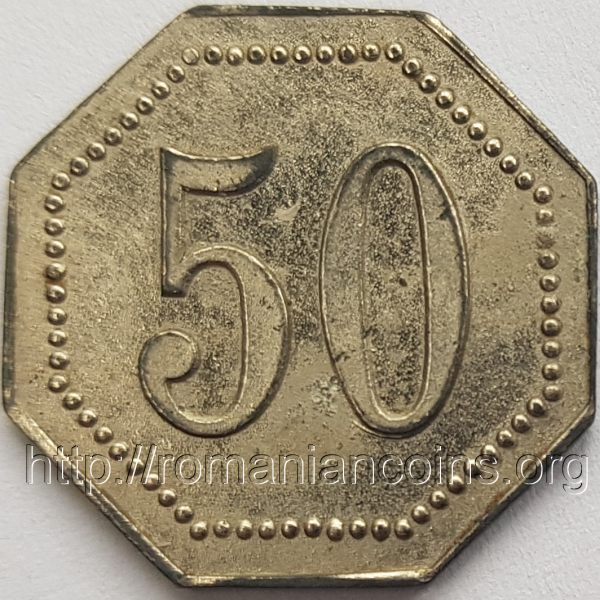
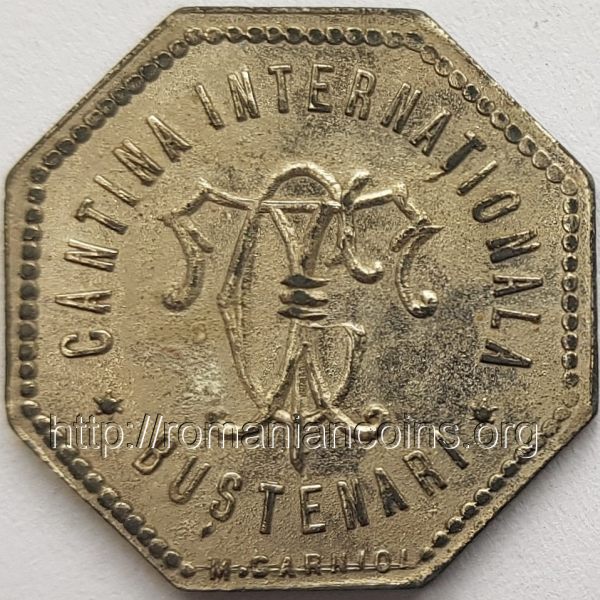
octagon, width 20 mm, silvered zinc, 2.14 g face value 50, outer pearl octagon | outer pearl octagon, with 7 edges with pearls, on the eighth edge being written the name of the engraver, M. CARNIOL, circular inscription CANTINA INTERNAŢIONALA ✶ BUŞTENARI ✶ meaning INTERNATIONAL CANTEEN, in the middle monogram CT |
 |
|
|
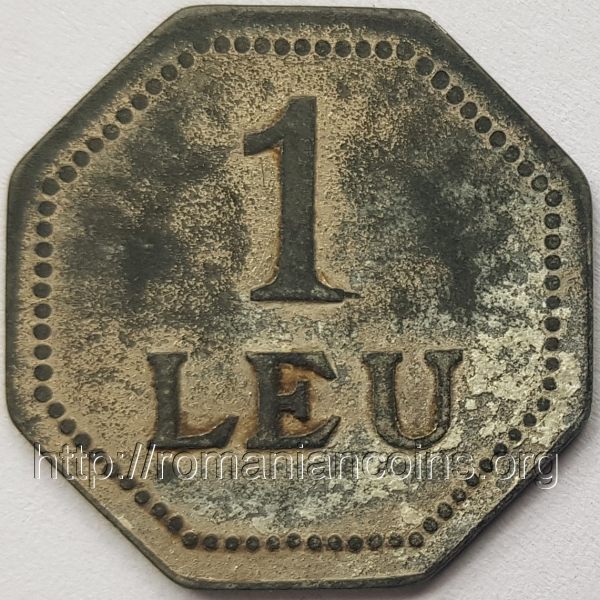
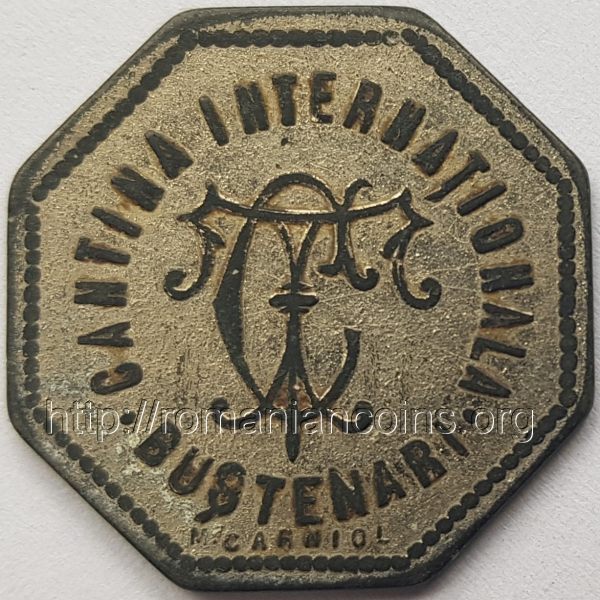
octagon, width 22 mm, silvered zinc, 2.75 g face value 1 LEU, outer pearl octagon | outer pearl octagon, in exergue the name of the engraver, M. CARNIOL, circular inscription CANTINA INTERNAŢIONALA • BUŞTENARI • meaning INTERNATIONAL CANTEEN, in the middle monogram CT |
About Buştenari
The village of Buştenari is part of Telega commune in Prahova county. At the last census, in 2021, the locality had a little over 500 inhabitants.
About oil exploitation at Buştenari
At Buştenari, oil was initially extracted through hand-dug wells, hand-dug holes in the ground that could reach up to 200 m deep, rarely more. The record for year 1906 was 265 m [1]. The wells were square in section, with a side of approximately 1.2 m at ground level, or circular in section. The side of the square decreased with depth, reaching a size at which it was no longer possible to work - that is approximately 0.75 m [1]. In such a small space, a single man could work for no more than three hours, so the well could advance by no more than 1.5 m per day under favorable conditions. For digging a well in favorable terrain, 7 lei/m was paid for the first 20 meters, and then an additional 7 lei/m for the next 20 meters and so on, with each new 20 meters the price increasing by 7 lei/m. The worker at the bottom of the well was always insured, being tied to the rope with which he had been lowered. The oil collected at the bottom of the well was brought to the surface just as water is brought from a well.
Later on derrick construction and mechanically drilled wells became prevalent, hence deeper depths being reached. Such wells were easy to recognize because they were always located underneath a derrick - a tower above the ground. Building a drilled well cost much more than digging a well by hand.
There is a lot of information about the exploitation of oil in Buştenari, most of which is spread in various publications from the early years of the 19th century. There are also a few studies published in the last years. For example, from [2] we learn that on May 1, 1900, the oil transport pipeline from Buştenari to Băicoi was inaugurated. Two initiators and financiers of this pipeline are also given, Messrs. Sfetescu and Shapira. There was a CFR station in Băicoi since 1879, as well as an oil refinery. From a book published in 1907 [1] we learn that from Buştenari to Băicoi the oil flowed through the pipeline by gravity, based on the elevation difference between the two localities, without the need for pumps. The transport of the oil needed to fill a wagon tank (a "vagon" was an old Romanian measure of mass, equal to 10,000 kg) over almost 19 km cost 30 lei. In 1906, the diameters of the transport pipes in Prahova County were between 2 and 5 inches [2] (1 inch is equal to 25.4 mm).
In the issue of April 17, 1905 of the hebdomadary "România economică" ("Economic Romania", published bilingually, in Romanian and German) [3], the oil production recorded in March 1905 in Romania is given. The Buştenari area is in the lead, both in terms of number of producers and in terms of production. For example, in March 1905, the "Buştenari" Company produced 7308 t, Telega Oil Co. - 3228 t, Arnhemsche Petrol. Maatschappij - 1073 + 133 t, Soc. "Internaţionala" - 2267 t, Soc. "Steaua Română" (Romanian Star) - 8412 t, Riske, Popescu & Ionescu - 125 t, etc. In total, 30 oil exploitations are listed only in Buştenari.
Also from [3] we learn about several mining concessions / leases of land plots in the area called Călinet in the commune of Telega, part of the Buştenari area. Thus, six locals from this commune granted to Mr. Karl Riske several plots of land (one pogon, two pogoane and five pogoane, where "pogon" is a unit of area of about half a hectare), for the purpose of oil exploitation. A sum was paid upon signing the contract (between 500 and 1300 lei per pogon), plus 1500 lei per year for each “drilled and productive” well. The well was considered productive if it supplied at least 5,000 kg of oil per day.
In [1] it is shown that in Buştenari the first hand-dug wells were installed in 1883 by a company named Thoiss & Co. At the beginning of year 1907 in the Buştenari-Recea area there were 135 producing hand-dug wells, 68 in various stages of the digging process, 174 abandoned, 60 suspended) and 544 drilled wells (307 producing, 129 in operation, 61 abandoned, the rest suspended).
A characteristic of the Buştenari oil area is the large number of exploitations and the fragmentation of the lands, which were originally owned by the villagers. In 1905, more than 7000 workers were active in the Buştenari area [4]. A different number is given by [1]: 5069 people worked in Buştenari. In any case, it is an impressive number of workers for such a small area.
About machines and equipment used in oil exploitation at the beginning of the 19th century [1]
Reference [1] also contains some interesting technical details about the heat engines used in the oil industry at the beginning of the 19th century. For example, the mechanized drilling of wells was mainly carried out by piston steam engines: "The motive power for most drillings is provided by steam, produced in multi-tube boilers or Cornwall boilers [...] which drive a steam engine of 24-30 horsepower".
The steam boilers used crude oil as fuel, less often residues left after oil distillation or even oil well gas. At that time, boilers produced steam at only 6 atmospheres (gauge pressure). According to the authors' estimates, about 10% of the oil production was burned to produce steam. Water consumption was also impressive. Water was brought from distances of 6-10 km and cost between 8 and 10 lei per 10,000 kg.
Electric motors were also used: "Electric motors are mostly found in Buştenari and partly in Cîmpina, at the operations of the <<Steaua Română>> company. The three-phase 240 V electric current was brought from Sinaia, on 11 kV lines. Gasoline engines were also in use.
The wells had to be artificially ventilated with bellows (from the point of view of a mechanical engineer, bellows are volumetric compressors). These bellows were very large, even 2.5 m wide, 3.5 m long and 1.5 m high. The valves used were actually wooden flaps. The flaps were sealed with rabbit fur and the flap stroke was limited by a belt. The air reached the bottom of the well through sheet metal pipes. Another interesting detail is that the tube used for ventilation was also used as a “talking tube” between those on the surface and the worker at the bottom of the well. For better voice transmission, a funnel was mounted at the top (plugged with a plug that was removed when speaking). As is known, sound is transmitted well through metal pipes.
The illumination of deep wells was done with mirrors that reflected sunlight.
At the beginning of the 20th century, Romanian refineries mainly produced kerosene, gasoline, oils and residues (oil fuel).
In 1906 Romania have exported petroleum products in large quantities. As a result, in the port of Constanţa there were no less than 16 tanks of 5000 m3 each. In the fiscal year 1905-1906, approximately 210,000 tons of petroleum products were exported through Constanţa, worth 14 million lei.
Also in [1], numerous technical terms specific to oil exploitation through manually dug wells appear, which today are just some tasty archaisms: borchiş (sand with water), puţar (worker who digs wells), vatră, hîrdău, crivac (windlass), hecnă (horse whim), porumbar, ţambră), ţămbruire, duf, lacărit, hăţaş.
When drilling a well, two teams usually worked, each for 12 hours a day. Each team had a "master driller", paid with 8 lei per day, three "driller assistants" (2 or 2.50 lei/day) and a "focar" (2.50 lei/day; today we would call him a stoker). Each well was manned by a master blacksmith and three assistants (paid 6 and 4 lei/day, respectively), a storekeeper-supervisor (5 lei/day) and a guard (2 lei/day).
About Societatea Petroliferă Internaţionala - International Petroleum Company
Reference [1] lists the main companies in the industry operating at the beginning of the 19th century, including the International Petroleum Company, founded in 1899 with Dutch capital of 12 million lei.
In the issue of June 26, 1899 of the weekly România Economică (Economic Romania) [5], information was published that a new company had been founded in Amsterdam with the aim of exploiting the oil fields in Romania, called "Internationale Rumeensche Petroleum-Maatsch". It was known that the new company had leased 434 hectares of land in three counties in Romania, on which there were 54 wells in operation and another 33 wells in various phases of construction.
In the Monitorul Oficial (Official Gazette) of July 30, 1905 [6], under the heading "Private Announcements", a translation from French of the founding act of the company (which had its headquarters in Amsterdam) was published. The company was called, in Dutch, Internationale Rumeensche Petroleum-Maatschappy (maatschappij meaning, obviously, society or company), or International Romanian Petroleum Company, in translation. There were 6,000 bearer shares, worth 500 Dutch guilders or florins each. There were 43 shareholders, individuals or companies, but the entrepreneur Henry van Saanen alone held 5,400 shares, because he had brought several concessions to the company for the exploitation of oil in the counties of Prahova, Dîmboviţa and Buzău, concessions already equipped with the installations and machinery necessary for exploitation.
Detailed information about the evolution of this society, during the interwar period included, is given in [7].
About Cantina Internaţionala - Buştenari tokens
Most likely, the tokens presented on this page were used at the International Petroleum Company canteen in Buştenari. There are vintage postcards that show the words "Cantina Internaţionala" ("International Canteen") or "Cantina şi biurourile Internaţionale" ("International Canteen and Offices").
The above tokens were described in [8] under serial numbers 782 and 783. There are similar pieces of smaller values, 5 and 10, also of octagonal shape. A total of 16 pieces bearing the indication Buştenari, issued by various companies, are listed here. Note the pieces inscribed SOCIETATEA PETROLIFERĂ INTERNAŢIONALĂ ROMÂNĂ / CANTINA SCHELEI BUŞTENARI 1901, with the values of 5, 20 and 50, as well as the pieces C. INTERNAŢIONALA, with the values of 5, 10 and 25.
The images of the tokens above are present on the site courtesy of an anonymous donor.
References
1. Tănăsescu I, Tacit V., Exploatarea petrolului în România. L'exploitation du pétrole en Roumanie. Bucureşti, Institutul de Arte Grafice „Carol Göbl”, 1907.
2. Parepa S., Petroleum Boom in Romania in the Years 1900. Buletinul Universităţii Petrol – Gaze din Ploieşti, Vol. LVIII, No. 3/2006, Seria Tehnică, 79 - 88.
3. * * *, România economică, an VII, nr. 16, Bucureşti, 17 (30) aprilie 1905.
4. Bîlgă Gh., Un important centru al petrolului românesc - Buştenari (1857-1948). Teză de doctorat, Universitatea Valahia din Tîrgovişte, Tîrgovişte, 2020, disponibilă pe platforma REI - Registrul Educaţional Integrat.
5. * * *, România economică, an I, nr. 3, Bucureşti, 26 (8) iunie 1899.
6. * * *, Monitorul Oficial nr. 96, 30.07.1905, p. 3600-3605.
7. Niţu Ionela, Pintilie D. O., Societatea petrolieră „Internaţionala Română” (Interum-Amsterdam) 1899-1930. În volumul „Administraţia Română Arădeană 95 de ani – Studii şi comunicări din Banat – Crişana”, vol. VIII, Colecţia Slaviciana – Serie nouă, Editura Vasile Goldiş University Press, Arad, 2014, p. 236-246, .
8. Schäffer E., România. Jetoane, semne valorice şi mărci, Guttenbrun [old German of Zăbrani village in Arad county], 2012.
|
Înapoi la pagina de selecţie!
|