
|
Guşoeni Estate tokens |
|
| 
|
|
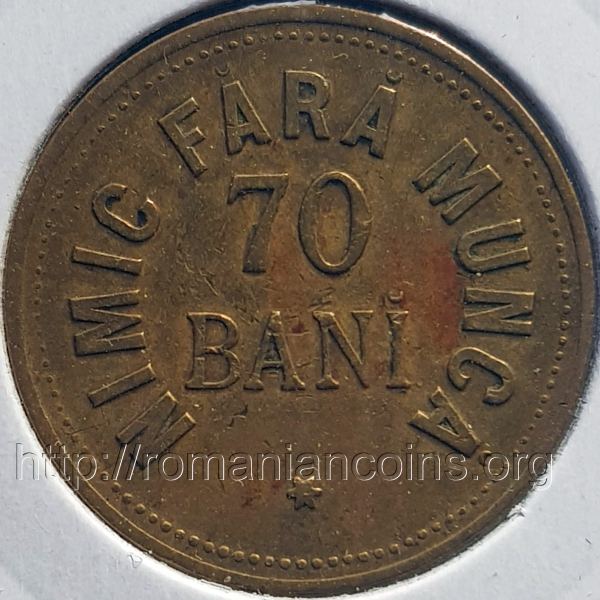
22 mm, 3.05 g, brass face value 10 BANI, outer pearl circle, face value 70 BANĬ, inscription NIMIC FĂRĂ MUNCĂ ✶ meaning NOTHING WITHOUT WORK |
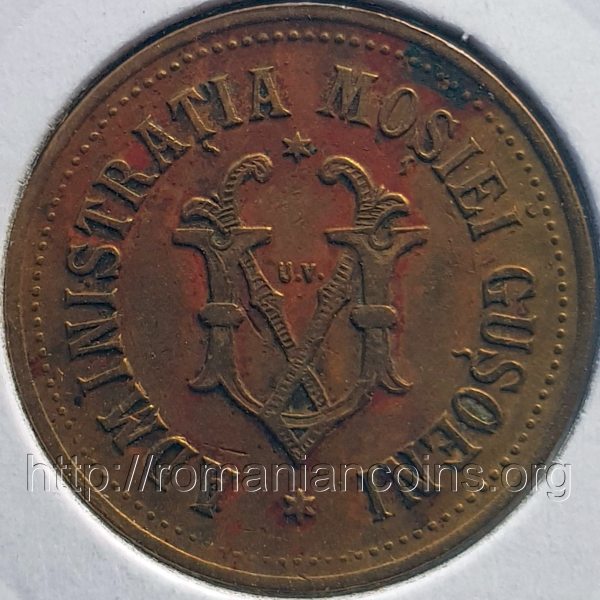
outer pearl circle, circular inscripion ADMINISTRAŢIA MOŞIEI GUŞOENI ✶ meaning GUŞOENI ESTATE ADMINISTRATION, in the middle monogram UV, inscription U.V., above the monogram ✶ |
About Guşoeni Estate
The commune of Guşoeni in Vîlcea County is located not far from the municipality of Drăgăşani. The commune occupies an area of 3665 hectares and is composed of six villages (Guşoeni, Burdăleşti, Dealu Mare, Guşoianca, Măgureni and Spîrleni), with approximately 1300 inhabitants.
According to [1], a book describing the situation in the years immediately preceding 1900, the rural commune of Guşoeni was located in "plasa Oltul de Jos" (Lower Olt; plasa was a territorial division unit comprising several communes; each county was divided in several "plăşi", plural for "plasă") and had 7 hamlets with approximately 1400 inhabitants (of which only 52 were literate). The commune covered 2310 ha. After the agrarian reform of 1864, a number of 76 peasants received 150 ha of land, taken from the state estate and from the estate of M. Ursanu. Besides the commune, the name Guşoeni was also used for two villages (one belonging to the neighboring commune of Amărăşti), a hill with vineyards, and a state forest (also in another commune).
According to [2], a book describing the situation in the first years after the First World War, the rural commune of Guşoeni in "plasa" Drăgăşani had 9 villages and almost 2600 inhabitants. There were three estates here: Guşoeni, of 700 ha, owned by Valerian Mircea and his sons, the Măgureni estate, of 750 ha (owned by Predescu C-tin D.) and the Spîrleni estate (owned by the heirs of Urseanu Ion).
Around 1860 the Guşoeni estate belonged to Matache Urşianu. The estate was divided between his descendants: Valerian Urşianu owned about 800 ha and his brother Ion about 400 ha [3]. In 1892 the Urşianu family built a winery in the village of Spîrleni. In the village of Guşoeni still lies a dilapidated Urşianu mansion [3].
Valerian Urşianu left the Guşoeni estate by will to his illegitimate son, Mircea Valerian, the lessee of the Guşoeni estate [4]. Ion also left the estate to his successor, Valerian Urşianu, known as Bibi. (From the family documents, now in the State Archives, it seems that the name Valerian was very popular in the Urşianu family [5].)
Valerian Urşianu (1845-1915) studied in Rome, where he defended his doctoral thesis in law in 1878. He was a university professor in Iaşi between 1880 and 1883, and then in Bucharest, where he twice became dean of the Faculty of Law. He also engaged in politics, being elected deputy and senator several times. He also published a volume of poetry [6].
The initials U.V. on the token can be linked to Valerian Urşianu, one of Matache's three sons. The initials could also come from Valerian Bibi Urşianu or his descendants, however they did not own the Guşoeni estate.
Given that Valerian Urşianu died in 1915, it is likely that these tokens were minted (and used) before this date. In [6] it is estimated that these pieces were introduced "around 1870"; for a piece sold on the Okazii website the seller gave the year 1900 as reference.
Refefences
1. Lahovari G.I., Brătianu C.I., Tocilescu Gr., Marele dicţionar geografic al Romîniei. Volumul III, Stab. Grafic J. V. SOCECŬ, Bucureşti, 1900.
2. Melbert, N., (editor), Anuarul „Socec” al României-Mari. vol. II- provincia, Editura „SOCEC & Co” S.A., Bucureşti, 1924-1925.
3. Sebeş Georgiana, Vâlcea. Conacul moşierului Matache Urşianu, lăsat în paragină de moştenitori. Semnalul Oltului, Râmnicului, Argeşului şi Severinului. 13 octombrie 2023.
4. Petrescu E., Comunităţi umane vîlcene, comuna Guşoeni - repere identitare. În volumul „Realităţi socio-economice, mentalitate şi identitate românească”. Conferinţa anuală a Institutului de Cercetări Socio-Umane din Craiova „C. S. Nicolăescu-Plopşor”, 5-7 octombrie 2023, Editura Cetatea de Scaun, Tîrgovişte, 2024.
5. Grigore Andreea, Fond familial „URŞIANU”, Rîmnicu Vîlcea, 2009.
6. Rosetti, Dim. R., Dicţionarul contimporanilor. Editura Lito-Tipografiei Populara, 1897.
7. Schäffer E., România. Jetoane, semne valorice şi mărci, Guttenbrun [old German of Zăbrani village in Arad county], 2012.
|
Înapoi la pagina de selecţie!
|