
|
100 lei gold 2025 - Elena Cuza, wife of prince Alexandru Ioan Cuza - 200th Anniversary of Birth |
|
| 
|
|
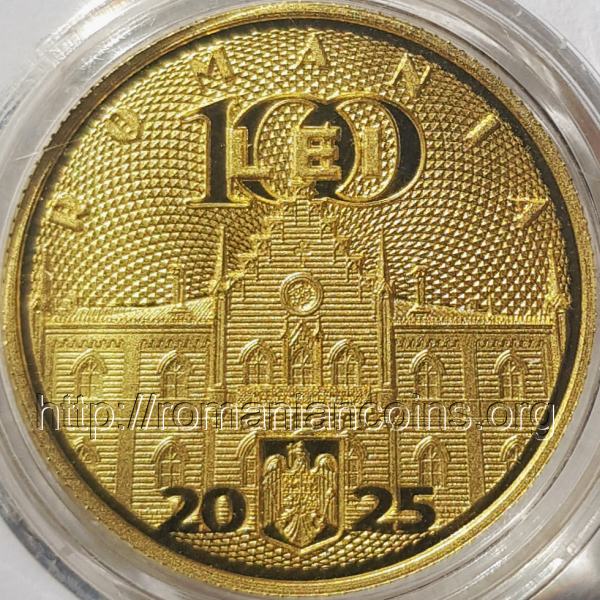
21 mm diameter, 6.452 g, 90% gold, reeded edge Obverse: ROMANIA, face value 100 LEI, year 2025, coat of arms of Romania, Cuza palace at Ruginoasa, Iași county | Reverse:
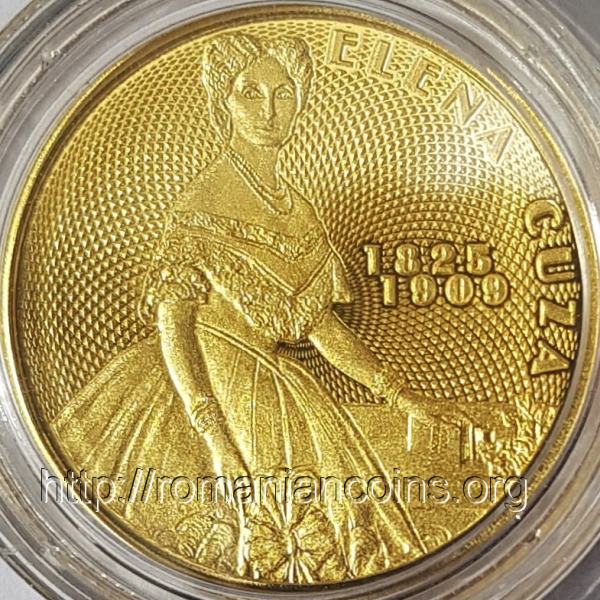
an image with the wife of prince Alexandru Ioan Cuza, inscription ELENA CUZA and years of her life, 1825 and 1909
Issuing date: 21st of July 2025 Maximum mintage: 1,000 coins |
About Elena Cuza
Elena Rosetti was born in 1825 in Iași. She married Alexandru Ioan Cuza in 1844. Elena Cuza was actively involved in cultural and social activities, charity and patronage [1]. She died in 1909 in Piatra Neamț and was buried in her mother's grave, at Solești in Vaslui County, where her parents' estate was located and where Elena had grown up. After [2] and [3] Pimen Georgescu, newly elected Metropolitan of Moldova in February 1909, requested that church bells be rung throughout Moldavia, so that "the river, the forest and the mountain would know that Elena Cuza had died".
In 1862, the foundation stone of the "Elena Doamna Asylum" was laid in Bucharest, where "found children" were to be housed. To mark the memory of this moment for generations, a medal was struck. Elena Cuza donated part of the money needed for the construction and urged other people to donate as well [1]. One wing of the building was completed in 1862 [3]. Some of Elena Cuza’s charitable deeds are mentioned in [6].
The image of Elena Cuza on the coin was originally created by Carol Popp de Szathmari (1812-1887), a painter and photographer from Bucharest born at Cluj, in Transylvania, at that time part of Austrian Empire. It is a lithograph from 1864.
Her bright memory was always kept alive by the Romanian people. In Iași, one of the main streets, located in the extension of Cuza Vodă Street, was named in her honor - Elena Doamna Street.
About the palace of Ruginoasa
The village of Ruginoasa is located in Iași county, between the cities of Tîrgu Frumos and Pașcani. In the early years of the 19th century, the Sturza family built a neoclassical palace on their estate (approximately 8,000 ha) in Ruginoasa [4]. Between 1847 and 1855, the palace was rebuilt in Gothic style by the logothete Costache Sturza. In 1857, the palace and the estate were mortgaged. Alexandru Ioan Cuza bought the estate and palace at auction in 1862. The Cuza family spent Easter 1864 in the renovated, furnished and decorated palace [5].
After his death, Alexandru Ioan Cuza's body was brought in the country and buried near the church next to the palace, on May 17/29, 1873. On this occasion, Mihail Kogălniceanu delivered a famous speech, in which he stated that "we are obliged to say that it was not His mistakes that overthrew Him, but His great deeds." A moving praise given by Kogălniceanu to Cuza’s reign was happily concentrated in the following fragment: "as long as this country will have a history, the most beautiful page it will have will be that of Alexandru Ioan I" [6], [7].
Elena Cuza lived for a few years at Ruginoasa and therefore the representation of the palace on the coin is completely justified. But a better idea would have been to have featured on the coin an image of the Solesti mansion, especially since the image of the Ruginoasa palace already exists in Romanian numismatics, being used for the obverse of the 10 lei 2020 silver coin dedicated to the anniversary of 200 years since the birth of Alexandru Ioan Cuza.
In 1944 the front line reached Ruginoasa, where heavy fighting took place, as a result of which the palace was destroyed. The palace was restored between 1967-1978. Since 1982 the palace has hosted the "Alexandru Ioan Cuza" Memorial Museum. Between 2008 and 2010 the museum was closed, the palace undergoing consolidation and renovation works [4].
References
1. * * *, Elena Cuza, Wikipedia, accesed August 2025.
2. * * *, Elena Cuza - Minunata Principesă, article published on 15th of June 2014 on "Istorie pe scurt" website, accesed August 2025.
3. Ichim Aurica, Ciubotaru M., Iftimi S. (coordonatori), Doamna Elena Cuza: un destin pentru România. Editura Palatul Culturii, Iași, 2011.
4. * * *, Palatul „Alexandru Ioan Cuza” de la Ruginoasa, Complexul muzeal Moldova Iași, accesed August 2025.
5. * * *, Palatul Cuza de la Ruginoasa, Wikipedia, accesed August 2025.
6. Giurescu C., Viața și opera lui Cuza Vodă. Editura Științifică, București, 1966.
7. Kogălniceanu M., Acte, scrieri din tinereță, discursuri. Editura Librăriei Leon Alcalay, București, 1908, book available on Restitutio digital platform of Biblioteca Centrală Universitară "Carol I" in Bucharest, accesed August 2025.
|
Back to selection page!
|