
|
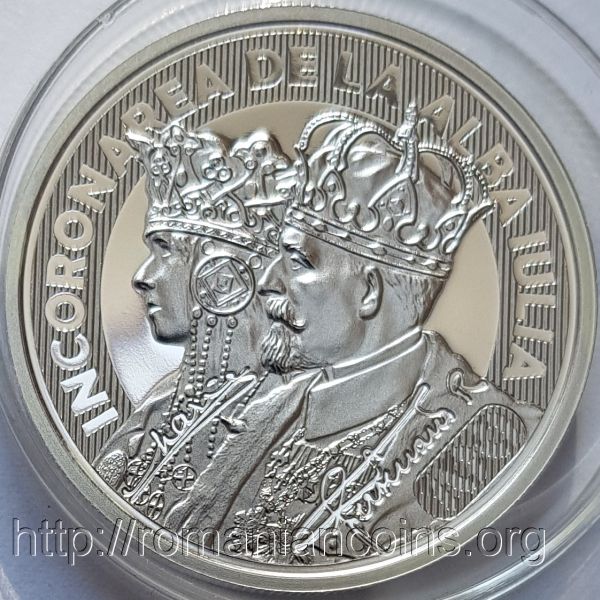
10 lei 2022 - 100 Years since the Coronation of King Ferdinand I and Queen Marie at Alba Iulia |
|

| 
|
|
37 mm diameter, 31.103 g, 99.9% silver, reeded edge Obverse: ROMANIA, coat of arms of Romania, face value 10 LEI, year 2022, a vintage image of the Coronation Cathedral in Alba Iulia; ROMANIA and 2022 are written above horizontally hatched areas | Reverse:
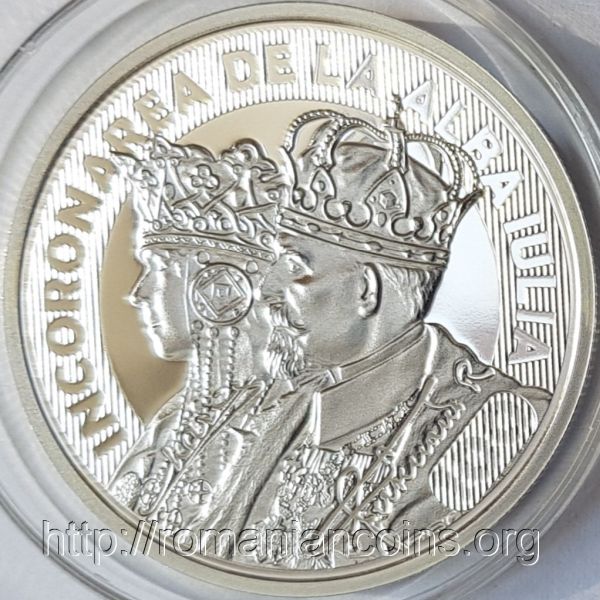
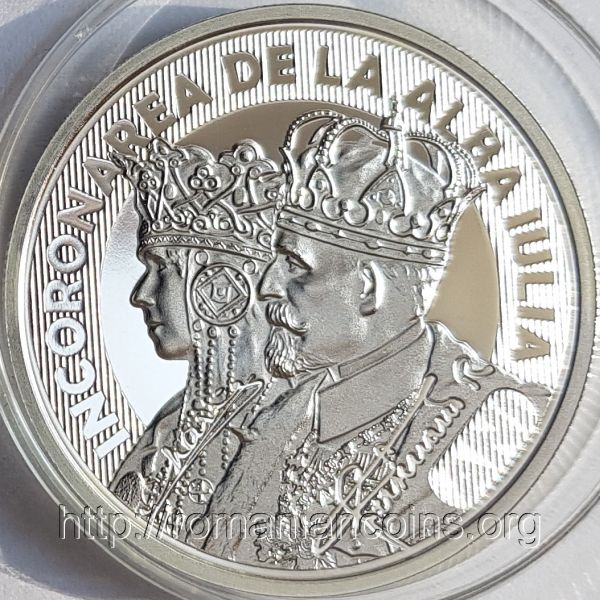
busts and signatures of King Ferdinand I and of Queen Marie, inscription INCORONAREA DE LA ALBA IULIA meaning CORONATION OF ALBA IULIA (written on a vertically hatched area), latent inscription 100 ANI meaning 100 YEARS
Issuing date: 31st of October 2022 Maximum mintage: 5,000 silver coins (and 1000 gold coins) |
| 
|
| right light: latent image 100 | left light: latent image ANI |
Republic of Moldova has also minted a coin dedicated to the centenary of the Coronation of King Ferdinand I and Queen Maria as sovereigns of Greater Romania. It is a silver coin of 100 lei from 2022.
Preparation for the Coronation Festivities
The first information about a future coronation ceremony of King Ferdinand appeared in the press in 1920. Thus, the newspaper Dimineaţa [The Morning] from Bucharest [1] published in its issue of July 14, 1920 a note stating that General Coandă [Constantin Coandă (1857-1932), father of the engineer Henri Coandă (1886-1972); in 1920 General Coandă held the position of President of the Senate] will be the president of a 10-person commission that will organize the coronation celebrations. The date and location of the event had not yet been established.
The newspaper Telegraful Român [Romanian Telegraph] of Sibiu from June 10/23, 1921 showed that the Coronation would take place in Alba-Iulia. In order to leave "a sign that will live forever in the consciousness of our nation", the members of the commission [here the architect Petre Antonescu (1873-1965) and the historian Nicolae Iorga are mentioned by name] proposed that the Coronation be held on the site of the old monastery built in Alba Iulia by Michael the Brave [2]. As the church had been demolished in the meantime and no one knew what it looked like, it had to be reconceived and rebuilt. Biserica Domnească of Tîrgovişte [Princely Church], founded by Petru Cercel (1556-1590, son of Pătraşcu cel Bun (1516-1557), a former ruler of Walachia, was chosen as model. The reason was the kinship with Mihai Viteazul (1558-1601), who was supposed to be the posthumous son of Pătraşcu - thus being brother to Petru Cercel.
Information about the planning of the Coronation was constantly appearing in the press. For example, the newspaper Înfrăţirea [Brotherhood] of Cluj from May 8, 1921 [3] reveals several statements made by General Coandă. The festivities at Alba Iulia were to take place sometime between September 24 and October 1, 1921. The anointing of the king [with holy myrrh or perhaps just with holy oil] was to take place in the church. The actual coronation was to be performed in front of the people, in an "artistically constructed" pavilion. The pavilion was also to be "definitive and durable", in order to remain the place of coronation of the kings of Romania forever.
The newspaper Evenimentul [The Event] from Iaşi of May 15, 1921 assured the readers that "work is feverishly underway to finish the Coronation Church and the monumental gate and the triumphal arches, through which the Sovereigns will make their entrance into the city" [4]. In Viitorul [The Future] of 12th of August 1921 [5] the "Program of the Sovereigns' Entry into Bucharest" was published, with a detailed description of the celebratory procession that would travel to the Metropolitan Cathedral the day after the Sovereigns' return from the events scheduled at Alba Iulia.
The coronation festivities were, for various reasons, postponed several times. Thus, in August 1921 the celebrations were postponed to May 10 [1922] "due to the impossibility of completing all these preparations". The new date had been confirmed to journalists by the Romanian politician Tache Ionescu (1958-1922), who was then the Minister of Foreign Affairs [6]. In March 1922 Neamul Românesc [Romanian Nation] wrote: "As an effect of the internal political situation the coronation celebrations were postponed again to August 14, 1922" [7]. The newspaper Lupta [Combat] of Bucharest announced on July 9, 1922 [8] a postponement sine die of the Coronation. The blame for the postponement, "Lupta" insinuated, would belong to the liberal regime led by Ion I.C. Brătianu (1864-1927).
In early September 1922, Dimineaţa [9] announced that the draft program for the coronation festivities had been discussed in a council of ministers and then sent for approval to King Ferdinand at Sinaia.
The Holy Synod of the Romanian Autocephalous Orthodox Church addressed a pastoral letter to the clergy and faithful on the occasion of the Coronation. It established the services to be held on October 15. At 11 a.m., all the bells in all the churches of the country will be rung to announce the great event [10].
On the Sunday before the Coronation the newly built Orthodox cathedral was consecrated. Four high hierarchs served: Metropolitan Nicolae Bălan of Transylvania (1882-1955), Archbishop Gurie Grosu of Chişinău and Hotin (1877-1943, became Metropolitan of Bessarabia in 1928), Bishop Vartolomeu Stănescu of Rîmnic (1875-1954) and Bishop Nicolae Ivan of Vad, Feleac and Cluj (1855-1936). The large bell was cast in Sibiu from cannon barrels and bears the commemorative inscription: "This bell was made for the Romanian church rebuilt on the site of Mihai-Viteazu's building in the days of King Ferdinand I, the unifier of the country and Ruler of all Romanians in 1922, the year of his coronation in Alba-Iulia" [11].
On October 11 the Ministry of the Interior had already published a communiqué announcing that factories and workshops would be open during the coronation celebrations [11]. Initially the schedule called for the 15, 16, and 17 to be non-working days.
On the morning of October 13 several special trains arrived at Sinaia, bringing high-ranking foreign guests to attend the Coronation [12]. First arrived was Queen Maria of Yugoslavia (1900-1961, who was the third child of King Ferdinand and Queen Marie). Then arrived the representative of the United Kingdom of Great Britain and Ireland, the Duke of York. This was Albert Frederick Arthur George (1895-1952), future king of the United Kingdom of Great Britain and Northern Ireland from 1936 on. He reigned under the name George VI. On the same train the delegation of the French Republic arrived, headed by Marshal Ferdinand Foch (1851-1929, former Supreme Allied Commander on the Western Front in 1918). The French delegation also included Romania's great friend, General Henri Mathias Berthelot (1861-1931, former commander of the French military mission in Romania in 1916-1917), as well as General Maxime Weygand (1867-1965). A third special train brought the envoys of Italy, Spain, Belgium, Denmark and Norway. The guests were greeted at the station by King Ferdinand himself [12].
The newspaper Înfrăţirea of October 13, 1922 [13] shows that military attachés were appointed to the foreign guests. For example, General Iacob Zadik (1867-1970) was attached to Marshal Foch.
Partidul Naţional (the National Party was, after the Union of 1918, the successor of the Romanian National Party in Transylvania and Hungary) and Partidul Ţărănesc (the Peasants' Party) issued press releases announcing their non-participation to the Coronation festivities. By this gesture, these parties - at that time the main parliamentary parties in opposition to the liberal government - wanted to draw attention to the undemocratic system of government applied by the liberals. The National Party would have wanted a new constitution to be adopted first, to which King Ferdinand would swear on the occasion of the Coronation [14].
The newspaper Dimineaţa of October 15, 1922 [15] related that in the capital, "sidewalk tickets" were being distributed for those wishing to witness the parade of October 16. The tickets were nominal. Each local councilor received 1,000 sidewalk tickets for distribution. The Police Prefecture and the Ministry of the Interior also distributed such tickets.
On October 14 the royal crowns were consecrated. They had been brought to Alba Iulia by Ion I.C. Brătianu, the president of the council of ministers, and by General Arthur Văitoianu (1864-1956), the minister of the interior. The service of the crowns was performed by the metropolitan primate Miron Cristea (1868-1939, who became the first patriarch of the Romanian Orthodox Church in 1925), metropolitan Pimen Georgescu of Moldavia (1853-1934), metropolitan Nicolae Bălan of Transylvania (1882-1955) and several bishops [16] including Gurie Grosu of Basarabia.
The events of October 15 in Alba Iulia
Here, in short, is the film of the day's events, according to the newspaper Viitorul of October 17, 1922 [16]:
- at 9:15 the royal train arrives;
- the royal family disembarks from the train, the mayor of the city welcomes the guests with bread and salt, according to tradition;
- the king was greeted by a host of current and former ministers, including generals Averescu and Coandă; out of the present opposition leaders, the most famous was undoubtedly historian Nicolae Iorga;
- at 9:30 a gala procession was formed further accompanying the royal carriage on the way to the cathedral;
- the sovereigns were greeted in the church porch by Ion I.C. Brătianu, president of the Council of Ministers and by Mihail G. Orleanu (1859-1942), president of the Assembly of Deputies, and by Mihail Pherekyde (1942-1926), president of the Senate;
- when entering the church, the sovereigns were greeted by the three metropolitans present;
- the king sat on the throne on the right and the queen on the throne on the left, surrounded by their family; in total, about 300 people entered the church;
- the metropolitan primate Miron Cristea entrusted the royal steel crown to the president of the Senate; the queen's golden crown was handed to the president of the Assembly of Deputies;
- the royal robes were then consecrated - these were entrusted to two generals commanding army corps;
- the sovereigns and the assistance then moved to the canopy erected in front of the bell tower, on a platform;
- King Ferdinand took the steel crown of Romania offered by Mihail Pherekyde, the president of the Senate, and put it on his head;
- King Ferdinand then took the golden crown from Mihail Orleanu (the president of the Assembly of Deputies) and crowned the queen with it; then he lifted the queen (she had knelt before the king), hugged her and kissed her on the forehead;
- loud cheers greeted the events; many people in the audience cried with joy; bells rang, and the army fired numerous cannon shots in honor of the Coronation;
- speeches by the presidents of the chambers of parliament followed, and subsequently King Ferdinand's response;
- wearing the crowns and the ceremonial robes, the sovereigns went to the prepared apartments; they were accompanied by the most distinguished guests; here they signed a commemorative act of the Coronation, so that the memory of the great event would be preserved forever;
- recognizing Marshal Foch and General Berthelot heading towards the royal apartments, the crowd spontaneously greeted them with cheers and shouted "Vive la France!", "Vive marechal Foch!" and "Vive general Berthelot!", which greatly moved the French;
- at 12 o’clock a gala banquet took place; tables were laid in the Union Hall for princes and foreign missions, members of the government, and clergy; the menu was produced and served by the Capşa house [arguably, the most distinguished restaurant in the country] in Bucharest;
- a lunch for parliamentarians and other guests took place at the theater; in specially arranged barracks around the monastery, a feast for the people took place, which was allegedly attended by tens of thousands of peasants from all corners of the country;
- at 2 p.m. on the plateau in front of the monastery, the parade of troops took place, which had previously been reviewed by the sovereigns; for this part of the festivities, Queen Marie bore the uniform of a cavalry general;
- Prince Carol (Charles in English, the future King Carol II) also took part in the parade, leading a division of mountain troops;
- after the parade, the sovereigns set off for the railway station, whence the royal train departed at 6:30 p.m..
The events of October 16 in Bucharest
The 16 was a bit rainy in Bucharest, but the rain did not diminish the enthusiasm of the people in any means or fashion. Here, also in brief, is the film of the events of Monday 16, according to the newspaper Viitorul of October 17, 1922 [16]:
- at 9:45 a.m. the train with the foreign guests (the Duke of York, Marshal Foch, General Berthelot, etc.) arrived at the Mogoşoaia station [this is the royal railway station in Bucharest, currently called the Băneasa station]; a special platform was built for this event; while waiting for the sovereigns, the government and the foreign guests took their seats on the platform;
- at 10 a.m. the royal train arrived at the station; the locomotive was decorated with fir branches and national flags; the first to get off was King Ferdinand, carrying in his left hand the mace that he had received on May 10, 1920;
- then Queen Marie alighted, followed by the Queen of Greece and the Queen of the Serbs, Croats and Slovenes (the two queens being the daughters of Queen Marie);
- a gala procession was formed, led by King Ferdinand, who mounted a white horse; then the Duke of York, Prince Carol, Marshal Foch, French generals, other foreign guests, as well as all officers with the rank of general, mounted;
- three gala carriages followed, with Queen Marie in the first;
- in front of the royal procession eight military bands from various regiments advanced; following the bands, the flags of the military schools followed, as well the flags of the regiments; a squadron of the royal escort concluded the procession;
- the procession went along the road [today it would have traveled a stretch of the Bucharest-Ploieşti road, then on "Regele Mihai I" Boulevard (King Michael I)] to the new triumphal arch replacing the former arch [that had been erected for the entry into Bucharest of the Romanian sovereigns on November 18 (old style) / December 1, 1918, just a hasty and temporary construction; for the Coronation a new arch was erected (approximately on the same site as the current, third one), also in a hurry, also temporary, based on the project of the architect Petre Antonescu];
- along the road between the train station and the arch (and also on Calea Victoriei) were lined up, in folk costumes, the almost 10,000 mayors of localities in the country, all arrived in Bucharest to take part in the events on the 16 and 17;
- after the flags passed under the triumphal arch the mayor of Bucharest, Gheorghe Corbescu, came out to greet the king, welcoming him in the capital city with bread and salt; the mayor delivered a welcoming speech, and the king in turn delivered a response;
- the king's passage under the arch was greeted by the cheers of the crowd; the audience threw white and red flowers; several colored rockets were fired, announcing to the inhabitants that the king had entered the capital (in [17] it is additionally mentioned that the rockets were in the national colors, and that the sovereign's passage under the arch was greeted bz 101 cannon shots);
- the procession then went to the the metropolitan cathedral, following a route along Calea Victoriei;
- at 11:45 the procession arrived at the Metropolitan Hill; at the entrance to the the cathedral the sovereigns were greeted by the metropolitan primate Miron Cristea, who carried a cross and the Holy Gospel; the king and queen then sat on the royal thrones, and a divine service followed;
- after the service, a snack followed in the Chamber of Deputies headquarters (at that time, located in the building next to the cathedral; today the building is the property of the Romanian Orthodox Church, hosting the Palace of the Patriarchate);
- then the king, accompanied by the same people as before, headed towards the statue of Michael the Brave (note that in [16] it is written that the journey was made on horseback, as on arrival; in [18] it is said that the same journey was made by automobile);
- the king and queen, the royal family, the foreign guests, sat to the specially built tribune;
- first the flags of all the regiments passed before of the tribune; the king received the parade of the flags standing;
- a historical procession followed, depicting important historical figures for Romanian history and soldiers from all eras: the Dacian-Roman era, the era of the "dismounting" (foundation) of the Romanian medieval states, the era of Mircea cel Bătrîn and Alexandru cel Bun, the era of Stephen the Great and Vlad the Impaler, the era of Michael the Brave, the era of Matei Basarab and Vasile Lupu, the era of Dimitrie Cantemir and Constantin Brâncoveanu, the revolution of Horia, Cloşca and Crişan, the revolution of Tudor Vladimirescu, the revolution of 1948 and Avram Iancu, the Union of the Principalities in 1859, the Independence, the Unification of 1918;
- the passage of the ethnographic procession followed, consisting mainly of the (almost) 10,000 mayors dressed in national costumes, each from one's specific region; when the mayors passed, the rain started again;
- the king and the guests then went to the palace; in the evening a gala dinner was held.
Several interesting photographs related to the 1922 Coronation, extracted from various archives, can be found on the website Restitutio 100. Coronation Route from Alba Iulia, made at the National Institute of Heritage.
Events on October 17 in Bucharest
The main events of Tuesday 17, according to the newspaper Viitorul of October 17, 1922 [16], were the following:
- at 10:30 in the morning, the reception of foreign missions took place at the palace; at 11:00 the diplomatic corps were received;
- at 12:00 the royal couple received the mayors' homage at Arenele Romane [Roman Arenas]; the king responded to the mayor's speech;
- at 1:00 p.m. the mayors' feast began in Carol I Park; the king and queen visited the mayors' table, being welcomed with new enthusiastic demonstrations;
- the menu served to the mayors was simple but nutritious: ţuică [Romanian traditional plum brandy] with olives as an appetizer, assorted cold cuts, cheese, cold veal steak with pickles, half a liter of wine and fruits - apples and pears; each guest received two earthenware plates decorated with the portraits of the king and queen; each mayor took the two plates home, to keep as a souvenir of their participation in the Coronation celebrations;
- at 3 pm the reception of the parliamentary bodies took place at the palace;
- at 9 pm a gala performance took place at the National Theater.
What else could be added? What was not revealed to the public in the press?
The attentive reader will have noticed that the role of the clergy in the Coronation was very limited and that only Orthodox hierarchs and priests took part in the events. It was also noted that nowhere was it said that the king and queen were anointed with myrrh, as would have been expected.
From [19] we learn that the metropolitan primate Miron Cristea drew up (and published) a draft of the way the coronation ceremonies were to be conducted from the religious point of view. The proposed program was "negotiated vigorously" with the coronation commission, with Brătianu and with the king’s representatives. The metropolitan wanted to anoint the sovereign with holy oil, while the king only wanted a thanksgiving service.
Also at [19] we find that upon the arrival of the sovereigns at the cathedral in Alba Iulia the liturgy had already been completed. The service was a Te Deum [Tedeum or Doxology, a hymn of praise, is a service of thanksgiving and praise to God, which takes place especially at festive times]. The royal robes and the queen’s crown were consecrated, with the formula "Behold, the crown of the Queen and the royal robes are consecrated by sprinkling with this holy water, in the name of the Father and of the Son and of the Holy Spirit". Four metropolitans then carried the royal crowns and robes. Miron Cristea then took the crowns, placed them on silk cloths with Romanian folk motifs, than handed over to the presidents of the Chambers. The mantles were given to generals, assisted by an officer each.
The Metropolitan Primate would have wanted that the ceremony of the crowning take place inside the church. But King Ferdinand was Catholic. The Pope of Rome had threatened him with excommunication if he had accepted to be crowned by the Orthodox Church in an Orthodox church [19].
In [20] it is stated that the project drawn up by Miron Cristea was read and annotated personally by King Ferdinand, who categorically refused, for him and his wife, to kneel for the reading of prayers and to be crowned by the patriarch.
There is an explanation for the king's refusal to receive Orthodox sacraments. Ferdinand was a fervent Catholic [21]. Maria was of the Anglican religion and such an interfaith marriage had required a dispensation from the Catholic Church. The dispensation was granted without any problems as long as the couple's descendants were Roman Catholic. But the Romanian constitution expressly stipulated that all the monarch's children had to be raised as Orthodox... and so all six children of Ferdinand and Marie were baptized in the Orthodox faith. Immediately after the baptism of Carol (the first child of the family, the future King Carol II) the Vatican imposed a canonical punishment on Ferdinand, preventing him from receiving Holy Communion. Romanian diplomacy always insisted on the Vatican lifting the ban, which was only lifted in 1927, on the eve of the king's death [21].
It seems that the papal nuncio, Archbishop Francesco Marmaggi (1876-1949, cardinal since 1935), played an essential role in preventing the king's coronation by the hierarchs of the Romanian Orthodox Church [20]. Even the blessing of the king's crown was blocked, even from afar! There was no need to bless the steel crown because it was supposed to have been blessed in 1881, before it was offered to King Carol I.
Although he had to accept a lot of requests that significantly reduced the role of the Orthodox Church in the ceremony, the metropolitan primate did not accept for other Christian confessions or religions - united with Rome, Catholics, Protestants or Mosaics - to say prayers during the coronation ceremonies. In fact, the 1866 Constitution explicitly stated that Orthodoxy "is the dominant religion of the Romanian State". As a result, representatives of other religions present at the ceremonies in Alba Iulia only witnessed the events taking place outside the cathedral. However, at the time, the Catholic Church forbade Greek Catholic clergy from entering Orthodox churches [20].
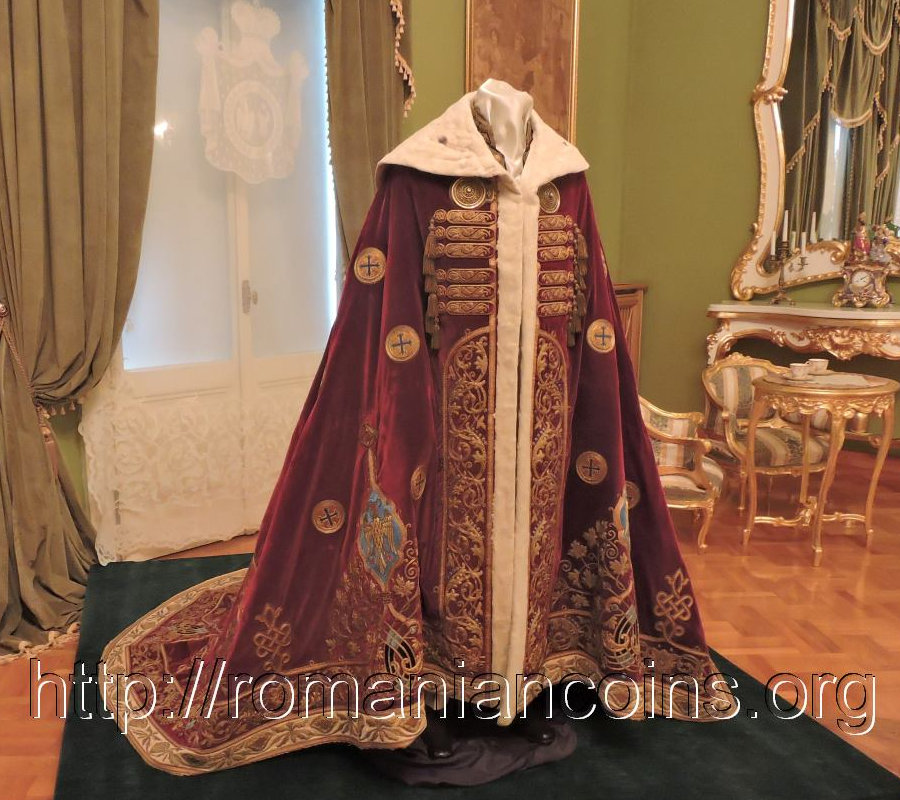
The Ceremonial Robes of the Sovereins
On the occasion of the Coronation, particularly sumptuous robes were prepared for the sovereigns.
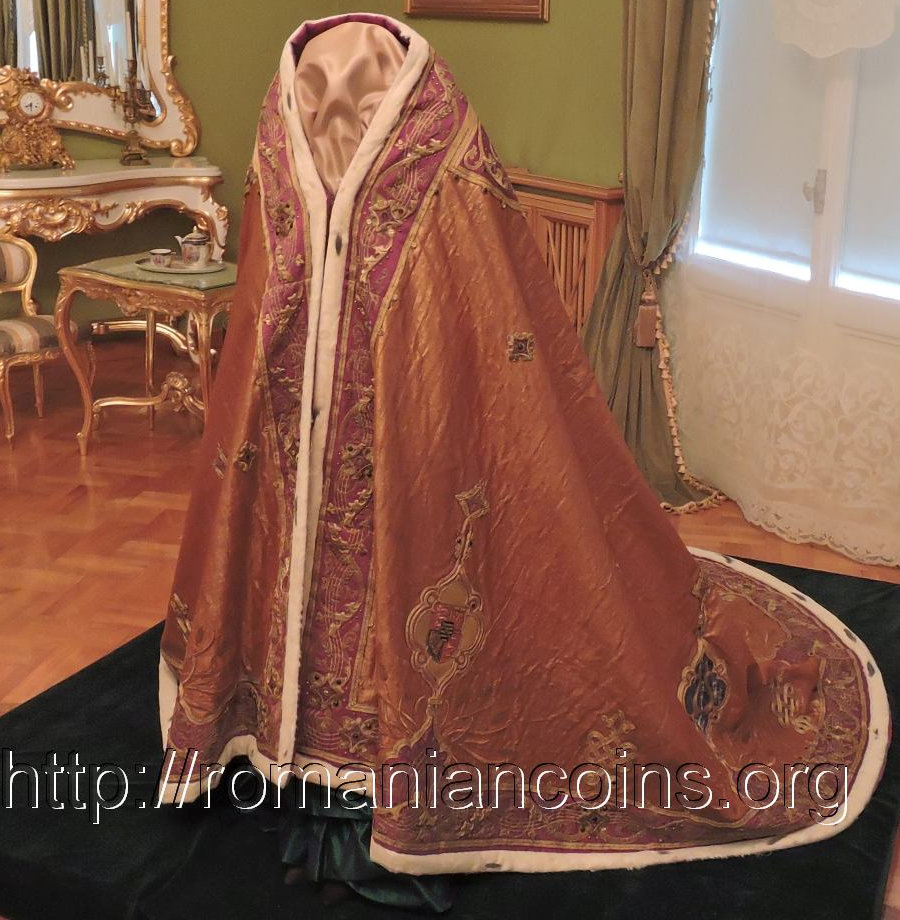
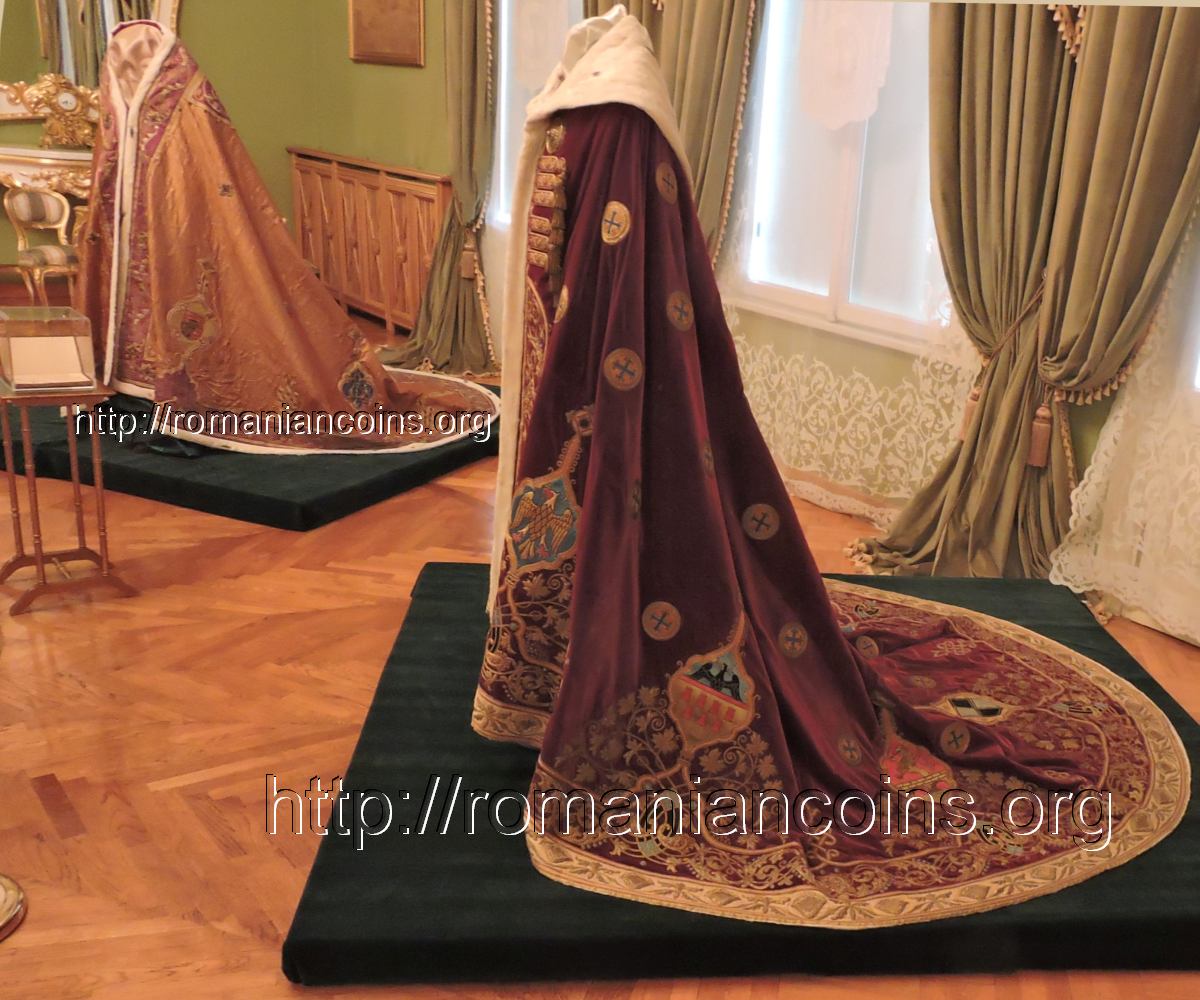
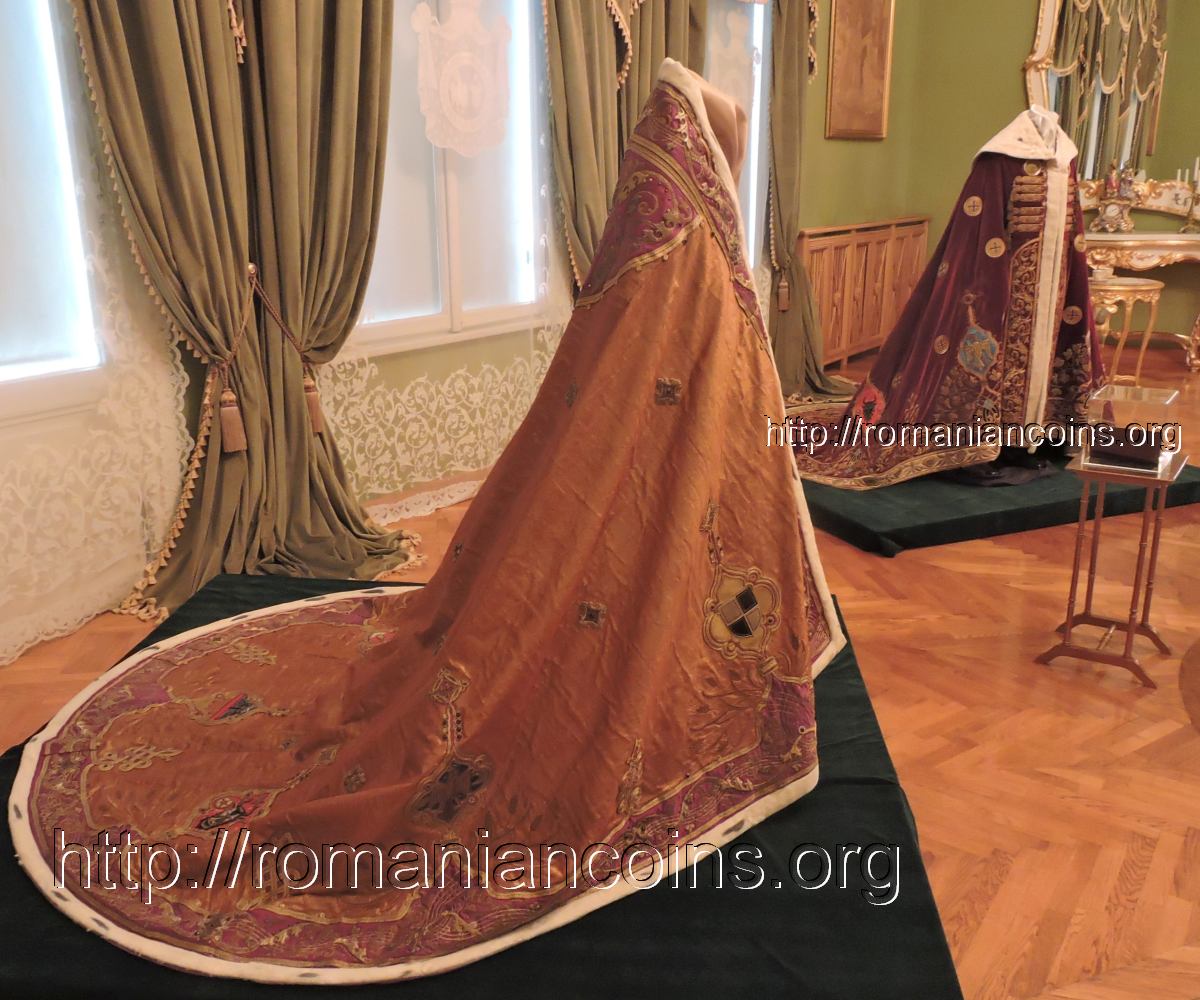
Coronation Medal
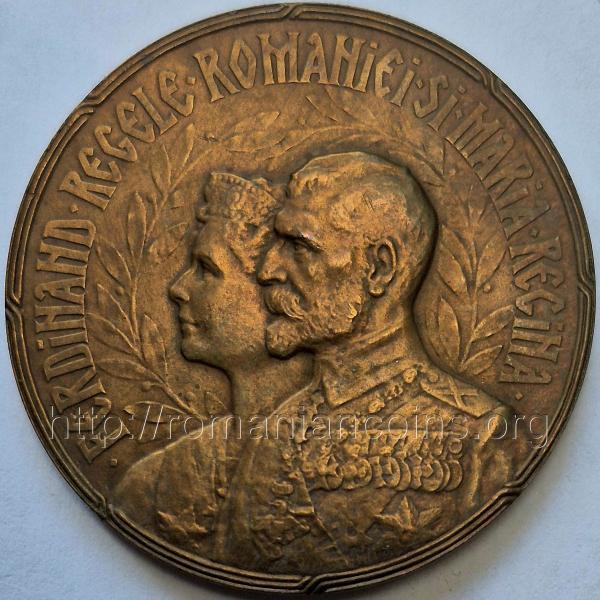
An official medal was minted on the occasion of the Coronation, made by the sculptor Constantin Kristescu (1871-1928) and executed in Paris at the Arthus Bertrand workshop [22]. The cited author criticizes this medal for its weak relief, for the twisted border that gives the impression that the edge is chipped, and because the inscription on the reverse is retrograde (being, it is said, placed after the medal was minted). There is also a reproduction of the official medal, but with a handle, and an anonymous popular medal [22].

| 
|
| 45 mm diameter; conventional scene (we can assume that the medal was designed and minted in advance of the Coronation, and therefore the artist had no way of reproducing a real image from 15th of October 1922): King Ferdinand on horseback, in military uniform and with a helmet on his head, carrying the mace in his right hand, in front of a military procession; the king's horse is led by a woman who of course represents Romania, having a laurel wreath prepared in her right hand; in the distance the Orthodox Coronation Cathedral in Alba Iulia retrograde incuse inscription ⬩ INTAIUL ⬩ REGE AL ⬩ TUTUROR ⬩ ROMANILOR ⬩ INCORONATU-S'A ⬩ LA ⬩ ALBA-JULIA ⬩ IN ⬩ 15⬩X⬩1922⬩ meaning THE FIRST KING OF ALL ROMANIANS WAS CORONATED AT ALBA-IULIA IN 15 X 1922 | in a laurel wreath the busts of King Ferdinand I and of Queen Marie, inscription ⬩FERDINAND⬩REGELE⬩ROMANIEI⬩SI⬩MARIA⬩REGINA⬩ meaning FERDINAND KING OF ROMANIA AND QUEEN MARIE |
Stamp series dedicated to the Coronation
On the occasion of the Coronation a series of postage stamps with seven values were issued. The models of these stamps were made by the painter Ludovic Bassarab (1868-1933). The artist's name appears on the 1 leu 1910-1914 and 2 lei 1910-1914 coins, he being the creator of the image of the peasant woman spinning on these pieces. It is interesting to note that the name of Ludovic Bassarab's daughter, Ioana Bassarab (1907-1967), appears on the 500 lei 1941 - Moldova lui ?tefan în veci a României coin, on which the artist modeled the face of King Michael.
The stamps were printed at the Bayerische Staatsdruckerei in Munich, but the perforation was done at the Stamp Factory in Bucharest [23]. The representation on the 6 lei denomination is very interesting. Here we see Queen Marie holding the model of the church in Alba Iulia [24]. The queen is dressed in medieval costume. This is a costume worn by Lady Chiajna (~1525-1588), daughter of the ruler of Moldavia Petru Rareş and wife of Mircea Ciobanu, ruler of Wallachia.
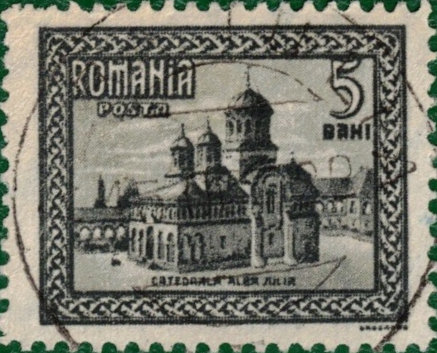


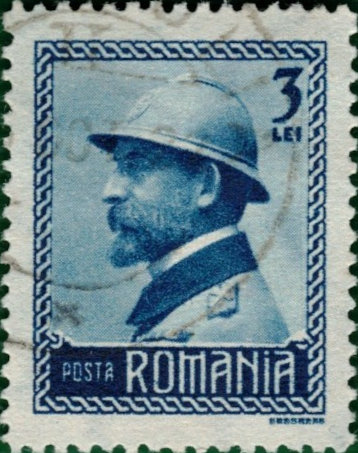

The information from the period newspapers above was found in the Arcanum Newspapers database.
References
1. * * *, Dimineaţa, an XVII, nr. 5034, miercuri 14 iulie 1920, p. 7, Bucureşti.
2. * * *, Telegraful Român, an LXIX, nr. 46, 10/23 iunie 1921, p. 3, Sibiu.
3. * * *, Înfrăţirea, an I, nr. 214, duminecă 8 mai 1921, p. 3, Cluj.
4. * * *, Evenimentul, anul al XXIX-lea, nr. 65, duminecă 15 mai 1921, p. 2, Iaşi.
5. * * *, Viitorul, an 14, nr. 4022, vineri 12 august 1921, p. 2, Bucureşti.
6. * * *, Patria, anul III, nr. 189, vineri 26 august 1921, p. 3, Cluj.
7. * * *, Neamul Românesc, an XVII, nr. 63, mercuri 22 Mart 1922, p. 2, Bucureşti.
8. L.T.A., O urmare a regimului brătienist. Nu se poate face încoronarea. Lupta, anul II, nr. 165, duminică 9 iulie 1922, p. 1, Bucure?ti.
9. * * *, Dimineaţa, an XIX, nr. 5686, sâmbătă 2 Sept. 1922, p. 1, Bucureşti.
10. * * *, Universul, an XL, nr. 208, sâmbătă 16 Septembrie 1922, p. 1, Bucureşti.
11. * * *, Viitorul, an 14, nr. 4373, miercuri 11 octombrie 1922, p. 4, Bucureşti.
12. * * *, Lupta, anul II, nr. 248, duminică 15 octombrie 1922, p. 2, Bucureşti.
13. * * *, Înfrăţirea, an III, nr. 633, vineri 13 octombrie 1922, p. 5, Cluj.
14. * * *, Adevărul, anul XXXV, nr. 11834, duminică 15 octombrie 1922, p. 1, Bucureşti.
15. * * *, Dimineaţa, an XIX, nr. 5729, duminecă 15 octombrie 1922, p. 3, Bucureşti.
16. * * *, Viitorul, an 14, nr. 4379, marţi 17 octombrie 1922, p. 1, 3, Bucureşti.
17. Mihai Daniela, Speteanu-Vasiliu Adriana, Tulai R., Târnă Mirela, Restitutio 100. Traseul Încoronării de la Alba Iulia, Institutul Naţional al Patrimoniului, accesat iulie 2026.
18. * * *, Dimineaţa, an XIX, nr. 5731, miercuri 18 octombrie 1922, p. 4, Bucureşti.
19. Petroaia L., O rânduială liturgică rară: slujba încoronării. Teologie şi educaţie la Dunărea de Jos, fasc. XII/2013, Editura Arhiepiscopiei Dunării de Jos, Galaţi, 2013.
20. Roşca P.-E., Ceremonialul încoronării de la Alba Iulia din perspectiva tradiţiei bizantine. Arhiva Someşană, XXI, p. 193-224, Muzeul Grăniceresc Năsăudean, Năsăud, 2022.
21. * * *, Regi catolici, regine protestante, copii ortodocşi. adevărul.ro, publicat 25.10.2012, ultima actualizare 08.08.2022, accesat iulie 2026.
22. Probota I., Medalistica noastră în 1922. Buletinul Societă?ii Numismatice Române, An XVII, Nr. 43-44, Iulie-Decembrie 1922, p. 102-105, Bucureşti, 1923.
23. Dragomir K., Surpăţeanu A., Catalogul mărcilor poştale româneşti '74.
24. * * *, Dacia, an IV, nr. 232, duminică 17 Septembrie 1922, p. 3, Bucureşti.
|
Back to selection page!
|