
|
10 lei gold 2025 - Votive Plaques from Germisara |
|
| 
|
|
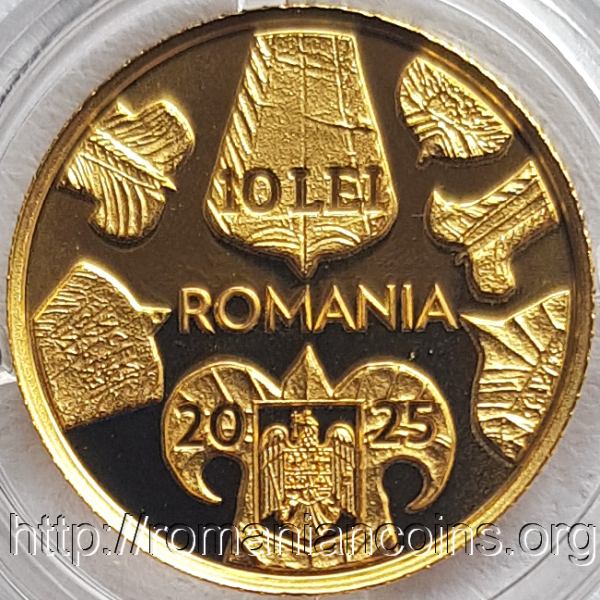
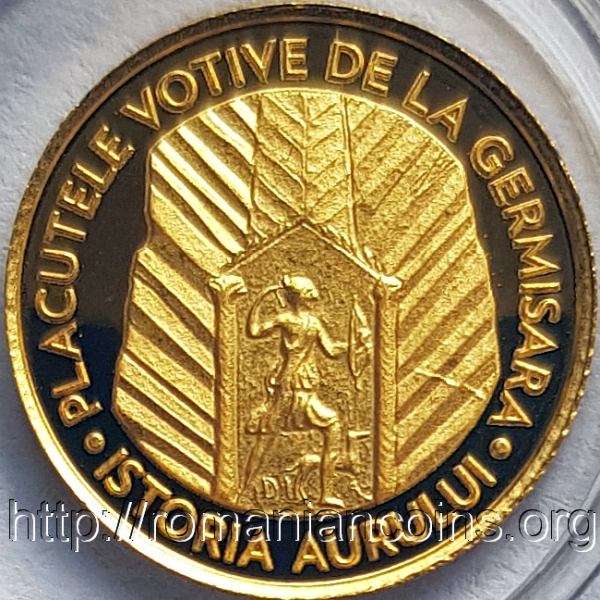
13.92 mm diameter, 1.224 g, 99.9% gold, reeded edge Obverse: face value 10 LEI, ROMANIA, year 2025, coat of arms of Romania, seven ends from several votive plaques discovered at Germisara (today, Geoagiu-Băi) | Reverse: a fragment of a votive plaque representing the goddess Diana hunting, inscription PLACUTELE VOTIVE DE LA GERMISARA • ISTORIA AURULUI • meaning VOTIVE PLAQUES FROM GERMISARA - HISTORY OF GOLD
Issuing date: 29th of December 2025 Maximum mintage: 1000 coins |
About Germisara, nowadays Geoagiu-Băi
In 1987, Oficiul Județean de Turism Hunedoara (Hunedoara County Tourism Office) wanted to build new spa facilities in the Geoagiu-Băi resort, exactly on the site of the thermal spring used in the Roman times. Rescue archaeological excavations were carried out by archaeologists from the Deva Museum. A rich archaeological material was found: 7 gold votive tablets, over 600 bronze and silver coins, an unfinished statue of the goddess Diana, several altars [1]. According to [2] and [3], the number of gold votive tablets discovered is 8 and not 7. The explanation for this difference is simple. An eighth gold votive tablet was discovered during the archaeological research at Germisara in 1990 [4]. Also from [4] we learn that the first tablet was found in 1986, as a result of geological drilling in the thermal spring.
Germisara is the ancient name of the locality Geoagiu-Băi near the town of Geoagiu (locality in Hunedoara County that became town in 2000). The name is confirmed by an inscription on an altar discovered at the same time as the tablets [1]. Germisara is a name of Dacian origin. It is usually translated as "Hot Water"; here germ- or zerm- = hot and sara or zara = water [1]. The name of the locality is also attested in some very old written sources. For example, in the Tabula Peutingeriana (a map of the roads of the Roman Empire, which has come down to us in the form of a medieval copy) the name is spelled Germihera.
All the plaques have a particular elongated shape and are wider at the base, sometimes characterized as leaf or wedge-shaped, perhaps due to the ribs that characterize them.
Towards the base, the plaques usually have an aedicule with the image of a deity or a "tabula" (tablet) with or without handles, in which dedicatory texts can be inscribed. The aedicule (also found in the form of aedicula, from "aedicula" in Latin) represents a small temple or just a niche bordered by two columns on which a pediment rests. A statue is usually placed under the pediment.
All pieces are made of very thin plates and decorated in the "au repoussé" technique. The smallest of all weighs just over one gram and is 7 cm high [1]. "Au repoussé" is a term of French origin and involves the creation of raised reliefs on a plate by striking the inner face.
About the plaque depicted on the reverse of the coin and dedicated to the goddess Diana
None of the plaques is represented on the coin in its entirety. The plaque represented partially on the reverse of the coin is described in [1] under number 1 and is the largest of all, both in size and mass. The piece is 17 cm high, 7.1 cm wide and 26.1 g in weight. The letters of the inscription are approximately 4 mm long. From the coin's booklet [3] we also learn the chemical composition: Au 79.9%, Ag 18.2%, Cu 0.3%, Fe 1.2%.
The main representation on the plaque is the aedicule, inside which the goddess Diana is represented. The goddess holds a bow in her left hand while with her right she takes an arrow from the quiver on her back. In the background there is an animal, interpreted by [1] as a hind, an animal that often accompanies the goddess. Another attribute of Diana is the hunting dog. At her feet are written the first three letters of her name - DI A - are written.
Below the aedicule is the rest of the dedicatory inscription: CORNE LIA MAR CELLIN. The inscription was completed as "Dia(nae) Cornelia Marcellin(a)", meaning to Diana (this object was dedicated by) Cornelia Marcellina. The lower part of the plaque ends in an arc. The upper part has two lateral lobes and a slight extension of the central rib outwards. Currently, this plaque belongs to Muzeul Civilizației Dacice şi Romane [Museum of Dacian and Roman Civilization] in Deva.
About the plaques represented fragmentarily on the obverse of the coin
Currently, seven of the plaques are at Muzeul Civilizației Dacice şi Romane [Museum of Dacian and Roman Civilization] in Deva, which offers large images of the owned pieces [7]. An eighth plaque - the one with the representation of the goddess of health Hygia [Hygia or Hygea is the Latin name for the goddess; in Greek the name is Hygieia, Hygeia or Hygiea] - was housed in 1990 (after [1]) also in Deva. It is currently owned by Muzeul Naţional al Unirii din Alba Iulia [National Museum of the Union] [2], [6]. The existence of the images allows the identification of the fragments of plaques that appear on the obverse of the coin.
On the obverse of the coin seven ends of plates appear, four being the lower parts and the other three the upper parts. Let us identify their positions on the dial of a clock with indicator hands (a classic mechanical clock). The upper piece is placed at 12 o'clock. Going around the circle clockwise we find representations at 13, 14, 16, 18, 20 and 22 o'clock.
The plate at 12 o'clock bears no inscription, but can be easily distinguished from the others by the four circular arcs visible at the bottom. In [1] it is described at position no. 6. The piece weighs 12.54 g.
The plaque at 13 o'clock is also anepigraphic. It is clearly distinguished from the others by the V-shaped lines visible at the bottom. In the aedicule are represented, from the waist up, three female characters identified as nymphs [in the Ancient Greek language nymph also meant girl]. The piece weighs 2.31 g and is 95 by 35 mm, with a thickness of 0.15...0.20 mm [4].
The 14 o'clock plaque is the top of the 20 o'clock plaque. It can be recognized by the shape of the ears, the right one being partially cut. On the coin it can be seen that the pointed part is on the right and the partially cut side is on the left. We must conclude that, unfortunately, this piece was represented incorrectly on the coin, as a mirrored image.
The bottom of the 16 o'clock plate is identifiable by the slanted lines on the left and right of the lower spur. In [1] it is described at position no. 4: it weighs 4.25 g and is 9.4 by 4.1 cm. In a tabula ansata there is the dedicatory inscription NYMPH IS LICI CALE, meaning that the plate was dedicated to the nymphs by Licinia Cale. Analyzing the picture of the piece on the museum website [7] it is seen that on the bottom side of the ansata tabula there are two slanted lines on the right side and five on the left side. On the coin it is seen that on the left side there are only two lines... This piece was unfortunately represented incorrectly on the coin, as a mirrored image. This conclusion is also confirmed by the letters CAL visible on the coin, which are in mirror image.
The 18 o'clock plate has the characteristic two bent horns. It is the upper part of the 16 o'clock representation, position no. 4 in [1]. If we analyze the picture of the piece on the museum website [7] it is immediately obvious that the upper spur has the left side made of one segment and the right side made of two segments (one being shorter than the other). On the coin, however, the side made of a single segment is placed on the right instead of the left... This piece was unfortunately represented incorrectly on the coin, in mirror image.
The 20 o'clock plate is also easy to identify by the hole in the spur at the bottom. The hole comes from the nail with which the plaque was attached to a substrate in antiquity. In [1] it is described at position no. 3: it weighs 3.33 g and is 11 by 4.6 cm. In an almost rectangular frame there is the dedicatory inscription: NYM BAEBIUS INGEN, meaning that the plaque was dedicated to the nymphs by Baebius Ingenuus. Although the coin is very small in diameter and this plate occupies only a small part of the obverse surface, a few letters from the inscription are still visible. On the first row one can see the letter N from NYM, on the second the letter B from the name of the person who dedicated the plate, and on the third row the letters NGEN can be distinguished. But these letters are all mirrored, from right to left! If we analyze the picture of the piece on the museum website [7], we immediately see that the pierced spur at the bottom is a little to the right of the leaf axis. On the coin, however, the spur is more to the left... This piece was unfortunately represented incorrectly on the coin, in a mirror image.
The image at 22 o'clock represents the upper part of the plaque with goddess Diana from the reverse of the coin. It can be recognized by the characteristic shape of the ears [7]. It should also be noted that in [1] (article published in 1990) the image of this piece differs slightly from the newer images. In the older images the left ear seems to have an additional small beak.
About Roman votive plaques
The pieces from the Germisara nymphaeum are not isolated discoveries. In 1990 in[1] it was mentioned that, for the entire Roman Empire, about 100 such votive plaques were known. In 2025 in [3] over 500 known plaques were mentioned, which were dated between the 1st century BC and the 4th century AD.
Images of some of these votive plaques can be seen on the Internet. Of the 28 plaques discovered in 1937 at Mauer an der Url in Austria (on the territory of the Roman province of Noricum, in the sanctuary of Jupiter Dolichenus), 16 are photographed for Wikipedia and available here. One can be seen here, on the website of the Vienna Museum of Art History (Kunsthistorisches Museum Wien).
A very elaborate silver plaque is in the British Museum. It was dedicated to Jupiter Dolichenus and was discovered in Germany, at Heddernheim, now a district of Frankfurt. It can be seen on the museum website. A large plaque - 529 mm high and 261 mm wide, weighing 286 g - discovered at Barkway, England and dedicated to the god Mars Toutatis is also in the British Museum. It can be seen here. A plaque representing the god Pluto is found at the Metropolitan Museum of Art in New York and can be seen here.
It would be extremely interesting to find out why the votive plaques discovered at Geoagiu-Băi, in the nymphaeum located, during Roman times, in the locality of Germisara, have the shape they do. It is easy to see that the width of the pieces increases from the top to the base, that there are horns or ears at the top, that numerous ribs cross a large part of the surface, that there is a sharp tip at the top (and, sometimes, at the bottom). All these particularities of shape are too unusual to have no justification. There must be an explanation.
The existence of the ribs is perfectly justified from the point of view of a mechanical engineer. All these plaques have a huge surface area compared to the mass of metal used. They are very thin pieces - at the ones from Germisara, the greatest thickness is almost a millimeter and could go as thin as 0.15 mm. As a guide, a votive plaque could have the thickness of 2-3 sheets of ordinary paper. Such a thin sheet will deform extraordinarily easily. To obtain a more rigid piece, the presence of numerous ribs is of great help. Moreover, the ribs in one half of the plate are oriented perpendicularly to those in the other half, for even greater rigidity. Of course, for the man in the Roman world, modern engineering considerations had no value. Being pieces dedicated to deities, the plaques were perhaps manufactured based on religious concepts.
In [1] it is noted that, although the tablets from Germisara as well as those from abroad were offered to the gods by people from the lower classes of society, an offering of 25 grams of gold, as much as the tablet of the goddess Diana, had in antiquity, as it does today, a fairly high intrinsic value. However, the use of very thin plaques as substrate may hide the attempt to make the object dedicated to the gods larger and therefore to appear, at least from a distance, more valuable than it actually was.
A very interesting scientific article [8] written by Belinda Crerar from the British Museum answers many of the questions we might have about votive plaques. The article has a very suggestive title, "Votive Leaf or Feather Plaques from Roman Britain".
To answer the question of whether the tablets represent leaves or feathers, [8] analyzes the arguments that can be brought for or against each variant. It shows that the representation is stylized and abstract and presents the idea that neither the craftsmen nor the believers who dedicated the plaques knew the significance of the shape of the objects. In other words, the original justification of the shape had been forgotten. People only knew that this type of offering should look like this.
Also in [8] it is shown that the plaques were made by stamping with the help of dies (with the entire model or only in portions) and that they were initially uninscribed. Any dedicatory inscriptions were executed later, after the sale of the plaque, according to the wish and at the dictation of the buyer. For this reason, some inscriptions are written carelessly, with mistakes, not very well framed, possibly scratched with a sharp object. A related hypothesis is also formulated, which would justify the existence of plaques that bear neither the image of a deity nor inscriptions: wasn't the goldsmith charging extra for the engraving of the deity's image and the engraving of the text, as an additional and optional service?
References
1. Piso I., Rusu Adriana, Nymphaeum-ul de la Germisara. Revista Monumentelor Istorice, an LIX, tom 1, 1990, Direcția Monumentelor, Ansamblurilor și Siturilor Istorice, București.
2. Oanță-Marghitu Rodica (coordonator), Aurul și argintul antic al României. Catalog de expoziție. ediția a III-a, Editura Conphys, Râmnicu-Vâlcea, 2018.
3. * * *, Istoria aurului. Plăcuțele votive de la Germisara. Banca Națională a României, București, 2025.
4. Pescaru E., Încă o plăcuță votivă din aur descoperită la Germisara (Geoagiu Băi). Sargetia. Acta Musei Devensis, XXI-XXIV, 1988-1991, Editura Polidava, Deva, p. 663-666.
5. Pescaru Adriana, Placă votivă . Institutul Național al Patrimoniului. Direcția Patrimoniului Digital. Bunuri culturale mobile clasate în Patrimoniul Cultural Naţional, accesat ianuarie 2026.
6. Ciobanu R., Placă votivă . Institutul Național al Patrimoniului. Direcția Patrimoniului Digital. Bunuri culturale mobile clasate în Patrimoniul Cultural Naţional, accesat iulie 2026.
7. * * *, Plăcuțele votive din aur de la Germisara – mărturii remarcabile ale epocii romane. Muzeul Civilizaţiei Dacice şi Romane - Deva, accesat iulie 2026.
8. Crerar, Belinda, Votive Leaf or Feather Plaques from Roman Britain. Published in Henig, M. (ed.) 2006 Roman Art, Religion and Society: New Studies from the Roman Art Seminar, Oxford 2005, BAR International Series 1577, Oxford, Archaeopress, 2006.
The History of gold series comprises:
- a set of four pieces of 500 old lei featuring the golden cache of Pietroasa (2001),
- the following 100 old lei coins with
- the Dacian helmet of Poiana-Coţofeneşti (1999, 2002 and 2003),
- the eagle from Apahida (2003),
- a Cantacuzinian engolpion (2004),
- the following 10 new lei with
- the Perşinari Hoard (2005),
- the Cucuteni-Băiceni hoard (2006),
- the rhyton of Poroina (2007),
- the Hinova hoard (2008),
- the Someşeni hoard (2010),
- the buckle of Curtea de Argeş (2011),
- the cross from Dinogetia (2011),
- the patera from Pietroasa Hoard (2012),
- the Four Gospels of Hurezi Monastery (2013),
- two ancient gold coins struck at Histria (2014),
- the crown of queen Marie (2015),
- the mace of king Ferdinand (2016),
- the crown of queen Elisabeth (2017),
- the 10 ducats 1600 coin with Michael the Brave (2018),
- the 50 lei with year 1922 coin (2019),
- some late Roman gold artifacts discovered at Carsium (2020),
- the polygonal vessels from the Pietroasa hoard (2022),
- the princely diadem of Buneşti-Avereşti (2023),
- the Apahida hoard (2024),
- the Germisara votive plaques (2025).
|
Back to selection page!
|